

- Actuators
- Adapters
- Air Blowers
- Air Conditioners
- Air Curtains
- Air Purifiers
- Anemometers
- Axial fans
- Ball Valves
- Belimo
- Blowers
- Brackets
- Brass
- Brazing Rods
- Capacitors
- Carrier Parts
- Clamp Meters
- Cleaning Products
- Coatings
- Compressors
- Condensate Pumps
- Connectors
- Contactors
- Copper Capillary
- Copper Coils
- Copper Straight Tubes
- Copper Strainers
Belimo EPIV Redefines Hydronic Balancing : Electronic Precision vs Mechanical Limits

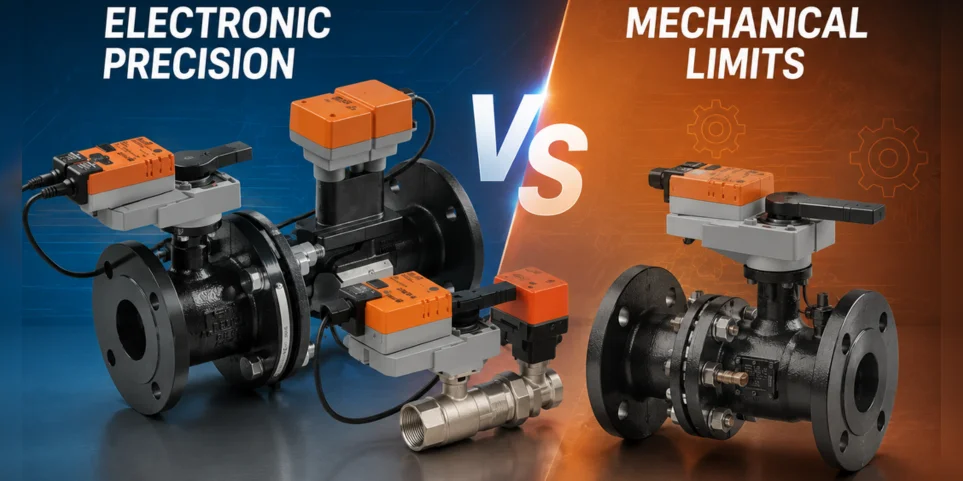
Belimo EPIV Redefines Hydronic Balancing : Electronic Precision vs Mechanical Limits
The Belimo EPIV (Electronic Pressure Independent Valve) provides several significant advantages over traditional Mechanical Pressure Independent Control Valves (MPICVs / PICVs) manufactured by competitors like Danfoss, Griswold, etc.
While all PICVs provide basic pressure independence and hydronic balancing, traditional mechanical versions rely on physical spring cartridges and diaphragms. The electronic, sensor-driven architecture of the Belimo EPIV elevates performance in five primary areas:
1. Massive Main Pump Energy Savings (Lower Δp Requirements)
- The Competitor Issue: Mechanical PICVs require a high minimum pressure drop (often 15 to 35 kPa) across the valve body just to compress the internal spring and activate the balancing cartridge.
- The Belimo EPIV Advantage: Because the EPIV uses an electronic flow meter and microprocessor logic instead of a spring, it requires virtually zero minimum operating differential pressure to balance the system. This lowers the total head pressure requirements for your primary HVAC pumps, yielding significant electrical energy savings.
2. High Resistance to Clogging and Media Debris
- The Competitor Issue: Mechanical PICVs route water through tight internal bypass channels and around delicate rubber diaphragms to regulate pressure. Scale, sand, or weld slag in the hydronic loop easily jam these components, causing the valve to lock up.
- The Belimo EPIV Advantage: The EPIV features a completely open, full-bore ball valve design. There are no internal cartridges or restrictive physical barriers. Debris passes through the valve body completely unobstructed, drastically lowering maintenance overhead and preventing premature valve failure.
3. Integrated Flow Verification vs. “Blind” Reporting
- The Competitor Issue: Mechanical PICVs are blind devices. Some competing electronic valves only calculate or guess the flow rate based on the actuator’s physical position. If the system lacks sufficient pressure or a coil is blocked, those valves still report a false theoretical flow to the BMS.
- The Belimo EPIV Advantage: The EPIV features a built-in ultrasonic flow meter providing true, real-time flow measurement. It measures the exact volume of water passing through the system, regardless of temperature or pressure fluctuations, guaranteeing precise environmental control and data accuracy.
4. Advanced Fluid & Glycol Compensation
- The Competitor Issue: Changes in fluid temperature alter the viscosity and density of water. If your system runs an anti-freeze mix (glycol), mechanical PICVs will experience significant calibration drift because a physical spring cannot adapt to a thicker fluid.
- The Belimo EPIV Advantage:: Belimo integrates a patented temperature and glycol compensation logic into the EPIV. You can program the exact glycol concentration into the valve firmware. The onboard sensor automatically adjusts its calculation matrix, maintaining perfect flow accuracy whether the system runs pure water or heavy glycol mixtures.
5. Automated, Remote Digital Commissioning
- The Competitor Issue: Setting or altering the maximum flow limit (V’nom) on a mechanical PICV requires a technician to physically access the valve (often above a ceiling or on a high mechanical rack) to turn a dial.
- The Belimo EPIV Advantage:: The EPIV connects directly to the building automation network via BACnet MS/TP, Modbus RTU, or MP-Bus. Engineers can scale, reprogram, change maximum flow rates, or perform full diagnostic health checks remotely from a computer workstation or via the Belimo Assistant Smartphone App.
Summary of Differences
| Feature Comparison | Belimo EPIV (Electronic) | Standard Mechanical PICVs |
| Minimum Pressure Drop | Ultra-low (Near zero) | High (15–35 kPa required for cartridge) |
| Physical Path | Full, open bore (No clogging) | Complex paths (High clogging risk) |
| Flow Reporting | True measured value (Ultrasonic) | None / Theoretical estimation |
| Glycol Correction | Automatic digital adjustment | None (Subject to mechanical drift) |
| BMS System Integration | Native digital protocols | Hardwired analog only |
Did you know?
In hydronics, V’nom (pronounced “V-prime nom”) stands for Nominal Volume Flow Rate (or Nominal Flow).
It represents the maximum, unthrottled maximum flow capacity that a valve or sensor is physically designed to measure and control under standard reference conditions.
Nominal Flow (V’nom) vs. Design Flow (V’max)
It is critical not to confuse V’nom with your project’s engineering design flow:
- V’nom (Nominal Flow): The maximum flow the valve can handle from the factory (e.g., a 2-inch valve might have a fixed V’nom of 6.3 L/s).
- V’max (Design / Maximum Flow): The actual maximum flow your specific HVAC coil needs based on load calculations (e.g., your coil only needs 4.5 L/s).
With smart valves, you program the valve so that its maximum limit (V’max) is capped at a percentage of the factory capacity (V’nom). In this example, you would tell the valve to clamp its maximum ceiling at 71% of its V’nom.
Common Units for V’nom
- Metric (SI):Liters per second (l/s) or Cubic meters per hour (m³/h)
- Imperial: Gallons per minute (GPM)
As the sole authorized distributor in the UAE, we stock a comprehensive range of Belimo solutions to deliver seamlessly on any project scale.