
- Actuators
- Adapters
- Air Blowers
- Air Conditioners
- Air Curtains
- Air Purifiers
- Anemometers
- Axial fans
- Ball Valves
- Belimo
- Blowers
- Brackets
- Brass
- Brazing Rods
- Capacitors
- Carrier Parts
- Clamp Meters
- Cleaning Products
- Coatings
- Compressors
- Condensate Pumps
- Connectors
- Contactors
- Copper Capillary
- Copper Coils
- Copper Straight Tubes
- Copper Strainers
How the Small Schrader Valve Powers Major HVAC Diagnostics

How the Small Schrader Valve Powers Major HVAC Diagnostic
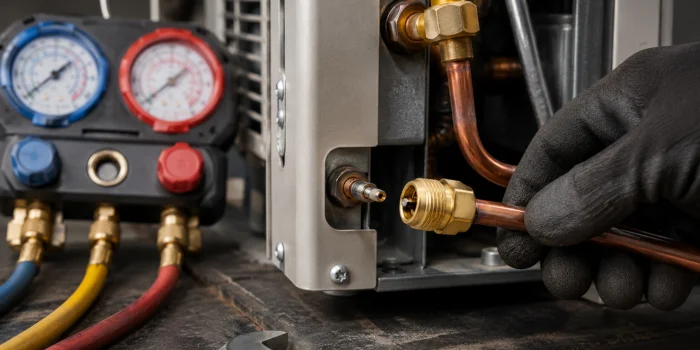
At its core, a Schrader valve (the exact same type of valve you find on a car or bicycle tire) acts as a service port for an HVAC system. It allows technicians to access the sealed refrigerant loop without letting the refrigerant escape into the atmosphere.
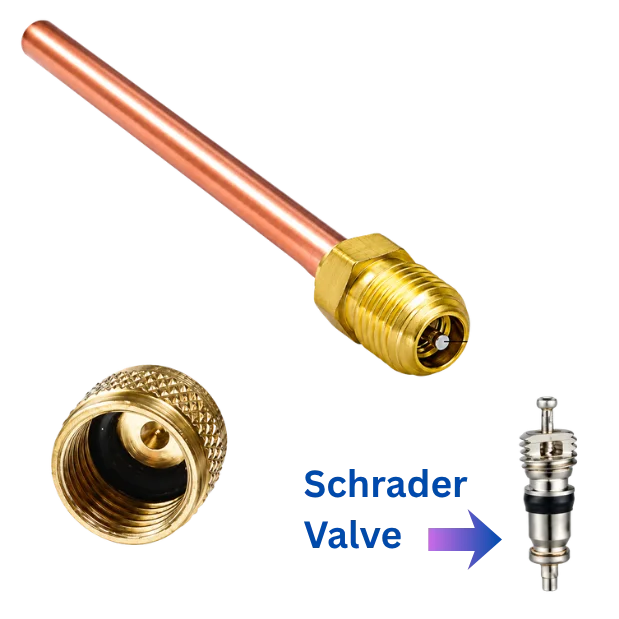
The terms “access valve” and “Schrader valve” are frequently used interchangeably in the HVAC industry, but there is a slight technical difference between the two.
An access valve (or service port) refers to the entire physical brass or copper assembly brazed into a refrigeration line.
A Schrader valve refers specifically to the spring-loaded mechanism inside that assembly.
Here is exactly what it does and why it’s critical:
1. The Gateway for Diagnostics and Service
HVAC systems are completely sealed. To know what’s happening inside, a technician needs to measure pressures, add or remove refrigerant, or pull a vacuum. The Schrader valve makes this possible:
- When you attach a manifold gauge hose: The depressor pin inside the hose pushes down the valve’s inner stem, opening the seal and allowing refrigerant pressure to flow into the gauge.
- When you detach the hose: The internal spring instantly pushes the valve stem back up, sealing the system shut again.
2. Components of the Valve
A standard HVAC service port consists of three main parts:
- The Valve Body: The threaded brass housing brazed onto the copper refrigerant lines (typically on both the suction/low-pressure side and the liquid/high-pressure side).
- The Valve Core: The small, removable mechanical piece inside that contains the spring-loaded pin and a small rubber seal.
- The Valve Cap: Crucial for HVAC. While a tire cap just keeps dirt out, an HVAC Schrader cap features an internal rubber O-ring. Because Schrader cores can develop tiny micro-leaks over time due to extreme temperature swings, the cap acts as the primary, leak-tight seal for the system.
3. Common Service Tasks
Technicians utilize these valves for almost every major maintenance task:
- Checking Pressures: Diagnosing subcooling, superheat, or identifying a faulty compressor.
- Charging/Recovery: Adding fresh refrigerant or recovering old refrigerant before a repair.
- Evacuation: Hooking up a vacuum pump to pull moisture and non-condensables out of the system. (Note: Technicians often use a core removal tool to temporarily remove the valve core during a vacuum pull to drastically increase flow speed).
When people say “Schrader valve,” they are usually referring to the entire three-part setup. However, technically speaking:
- The Valve Core is the actual “Schrader” mechanism itself (the spring-loaded pin).
- The Valve Body (the brass housing) is often called the access fitting or service port.
Why the distinction matters in the field:
If a technician says, “The Schrader is leaking,” they usually mean the tiny rubber seal on the valve core has failed.
Because it’s a distinct, removable piece, you don’t have to cut and braze a whole new brass body onto the copper line—you just use a core removal tool to swap out the tiny inner core, while the brass body stays permanently attached to the system.
Did You know?
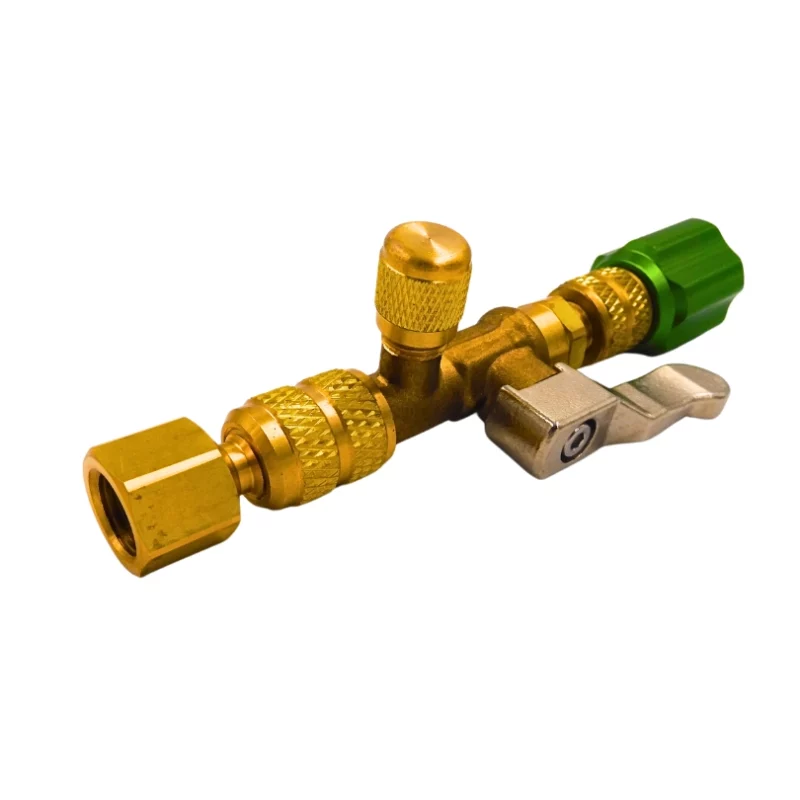
We have the WIPCOOL MVR-1 Valve Core Remover (https://wearehvac.com/product/wipcool-mvr-1-valve-core-removal/) that easily enables the technician to remove the inner core.