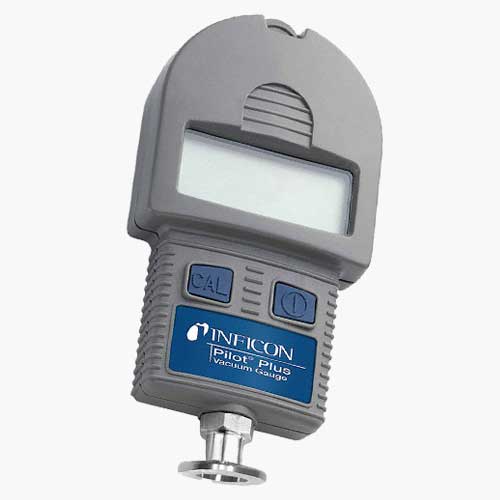

INFICON Pilot Plus vacuum gauge

Superior Accuracy, Filter-Protected Sensor, and Extended Battery Life Provide More Jobsite Productivity

Cautionary Advice:

Vehicles parked in direct sunlight can reach internal temperatures of 55°C to over 70°C within an hour, even when outside temperatures are only moderately warm.

Vacuum gauges have a maximum temperature rating of 50° celsius. Please do not keep vacuum gauges inside parked vehicles.

INFICON Pilot Plus Vacuum Gauge incorporates several innovative features for unsurpassed performance. Like the original Pilot Vacuum Gauge, its Pirani sensor provides greater accuracy and the ability to measure the entire vacuum process, from atmosphere down to one micron. You'll know instantly if your connections are vacuum-tight.

  • Operates for 45 hours on one 9V battery
  • Quick calibration specific to local pressure
  • Displays in micron, Pascal, Torr or millibar
  • Low battery indicator
  • Plastic storage case included

Advantages of Pilot Plus


Innovative filter protects sensor, eliminates need for cleaning


Measures from atmosphere to 1 micron


Auto shut-off after 60 minutes to conserve battery


Pirani sensor for better accuracy
.


Large, easy-to-read LCD display

Specifications

Base unit includes 9V battery, filters, storage case
Power Source (1) 9V alkaline battery, included
Display Unit

microns, Pascal, millibar, Torr

Display Range atm (760,000 microns) to 1 micron (0.01 mbar, 0.001 Torr, 1 Pa)

Note to All Customers


The INFICON Pilot Plus Vacuum Gauge is highly sensitive to heat and can suffer permanent damage if it is left inside a hot car.

Strict Temperature Limits

According to the official INFICON Pilot Plus Technical User Guide, the threshold boundaries for this tool are:

  • Operating Temperature: 32°F to 122°F (0°C to 50°C)
  • Storage Temperature: 14°F to 140°F (-10°C to 60°C) 

On a standard warm day, the stagnant cabin or trunk air of a parked vehicle can easily breach 140°F to 160°F (60°C to 71°C). This exceeds the maximum allowable storage temperature, which directly threatens the device's sensitive internal electronics.

Risks to the Gauge in a Hot Car

Leaving the tool inside a vehicle exposes it to three primary risks:

  • Pirani Sensor Miscalibration: The device relies on a highly sensitive Pirani thermal conductivity sensor to measure deep vacuum. Because a Pirani sensor determines vacuum by calculating heat loss from a tiny internal wire, extreme ambient thermal stress can cause permanent sensor drift or warp its internal calibration.
  • LCD Display Bleeding: The large digital LCD screen is prone to "blacking out" or permanently bleeding when exposed to localized temperatures over 140°F.
  • Battery Degradation: Unlike devices with custom built-in lithium cells, the Pilot Plus is powered by a standard 9-volt alkaline battery. While less prone to explosive thermal runaway than lithium, extreme car heat will degrade the alkaline battery chemistry, reduce its 45-hour runtime, and significantly elevate the risk of acid leakage inside the tool's housing. 

Safe Practices

    • Utilize the Provided Hard Case: Always store the gauge inside the plastic storage case included by INFICON. This shell provides a mild thermal buffer and physical protection from bumps. 
    • Bring It Indoors: Treat this precision diagnostic equipment like your smartphone; bring it inside a climate-controlled room when you wrap up your work for the day.
  • Avoid Immediate Use If Warm: If the tool gets hot, do not turn it on right away. Let it naturally acclimate back to safe operating temperatures (under 122°F) before running your vacuum calibration.