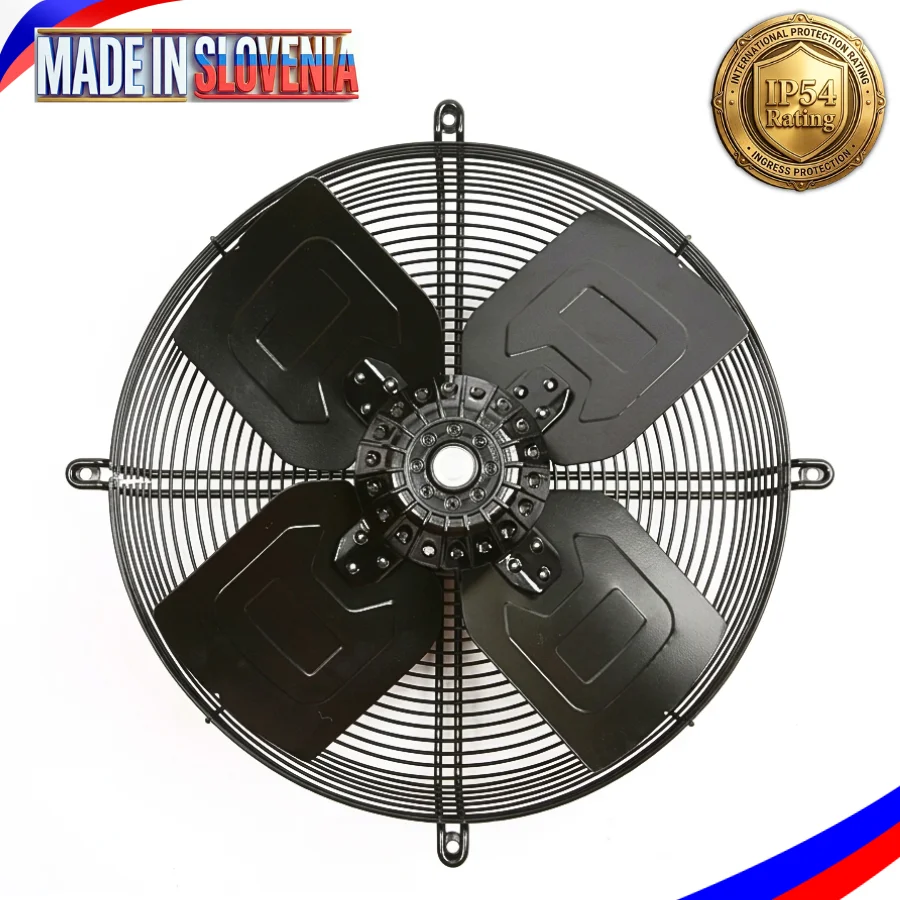

Hidria 450mm, 400V 3Ph Axial Fan

Made in Slovenia, Europe

The Hidria model R13R-4530A-4T2-35100 (manufacturer part code 0313-4-0465) is a three-phase, high-efficiency AC axial fan. This model features a 3-phase external rotor motor that supports dual-speed operation depending on whether you wire it in a Delta (Δ) or Star (Y) configuration. It has a sucking airflow direction and an outer blade diameter of 450 mm.

  • Fan Diameter: 450 mm
  • Model Number :R13R-4530A-4T2-35100

Technical Specifications

The performance metrics shift distinctly between the two wiring methods at a standard nominal voltage of 400 VAC:

Feature

Delta (Δ) Connection — High Speed

Star (Y) Connection — Low Speed

Nominal Speed

1350 RPM

1100 RPM

Power Consumption

360 W

230 W

Current Draw

0.70 A

0.39 A

Max Airflow Volume

5800 m³/h

4700 m³/h

🛠️  Mechanical & Physical Properties

  • Fan Diameter: 450 mm rotor blade sizing.
  • Overall Basket Outer Diameter: 515 mm attachment framework.
  • Airflow Pattern: Sucking (draws air through the basket/grill, across the blades and motor).
  • Static Efficiency Grade: N = 41.0 (Compliant with ErP eco-design directives).
  • Overall Static Efficiency: 32.0%.

🛡️ Insulation & Environmental Protection

  • Insulation Class: Class 155 (F) standard thermal rating.
  • Enclosure Protection: IP54 sealing against water splashes and dust.
  • Airflow Pattern: Sucking (draws air through the basket/grill, across the blades and motor).
  • Thermal Protection: Integrated thermal contacts (TK / Thermocontact) built into the windings. These must be wired to an external control unit to shut off power during overload faults.
  • Temperature Limits: Operates down to a minimum of -30 °C and can withstand up to a maximum ambient temperature of 70 °C.

🔌  Basic Wiring Framework

The fan utilizes standard 3-phase speed switching logic:

  • High Speed (Delta - Δ): Bridge links join terminal connections [U₁ and W₂, V₁ and U₂], and [W₁ and V₂] to the respective L₁, L₂, L₃ supply lines.
  • Low Speed (Star - Y): Tie terminals U₂, V₂, and W₂ together to create the star point, then feed L₁, L₂, L₃ directly into U₁, V₁, W₁.
  • Rotation Direction: Change direction simply by interchanging any two phases.