
- Actuators
- Adapters
- Air Blowers
- Air Conditioners
- Air Curtains
- Air Purifiers
- Anemometers
- Axial fans
- Ball Valves
- Belimo
- Blowers
- Brackets
- Brass
- Brazing Rods
- Capacitors
- Carrier Parts
- Clamp Meters
- Cleaning Products
- Coatings
- Compressors
- Condensate Pumps
- Connectors
- Contactors
- Copper Capillary
- Copper Coils
- Copper Straight Tubes
- Copper Strainers
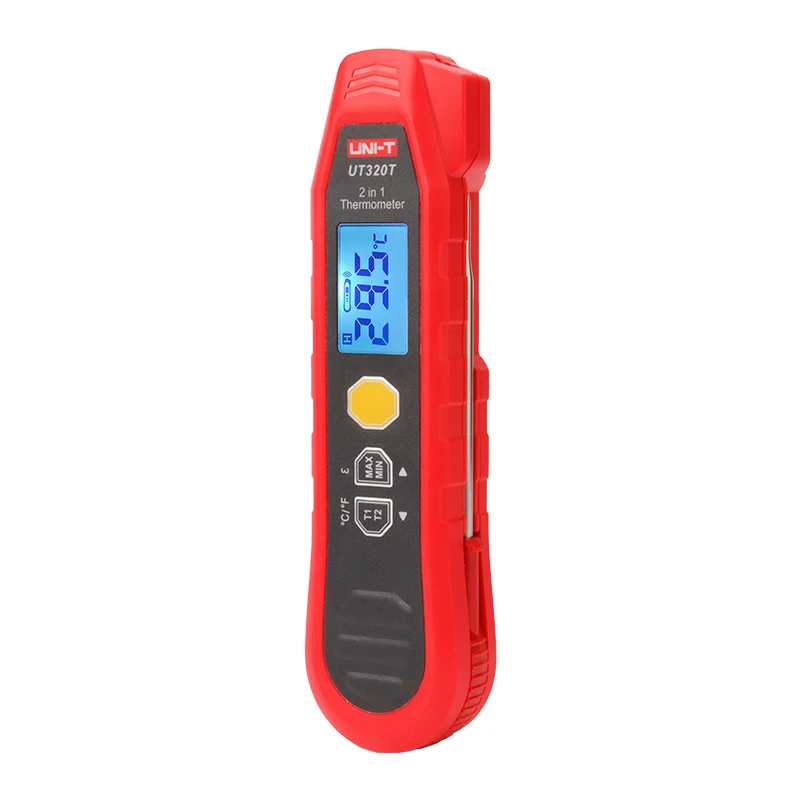
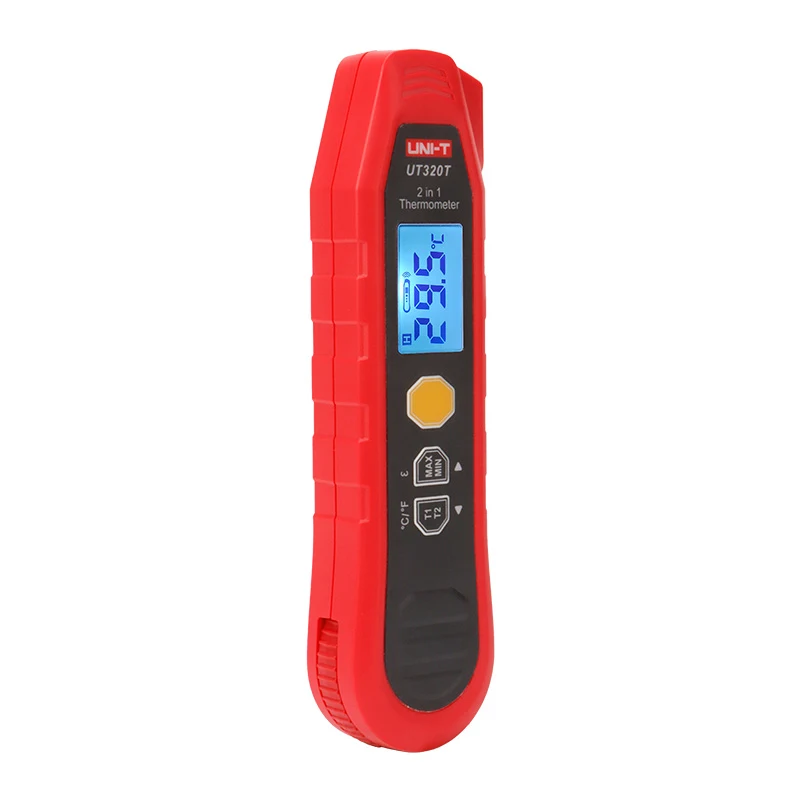
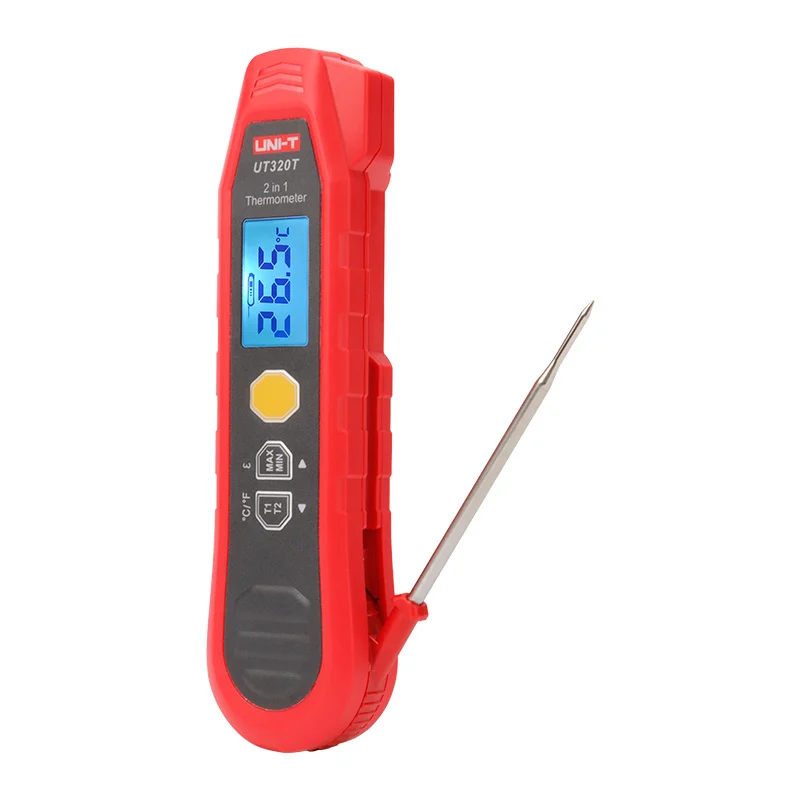
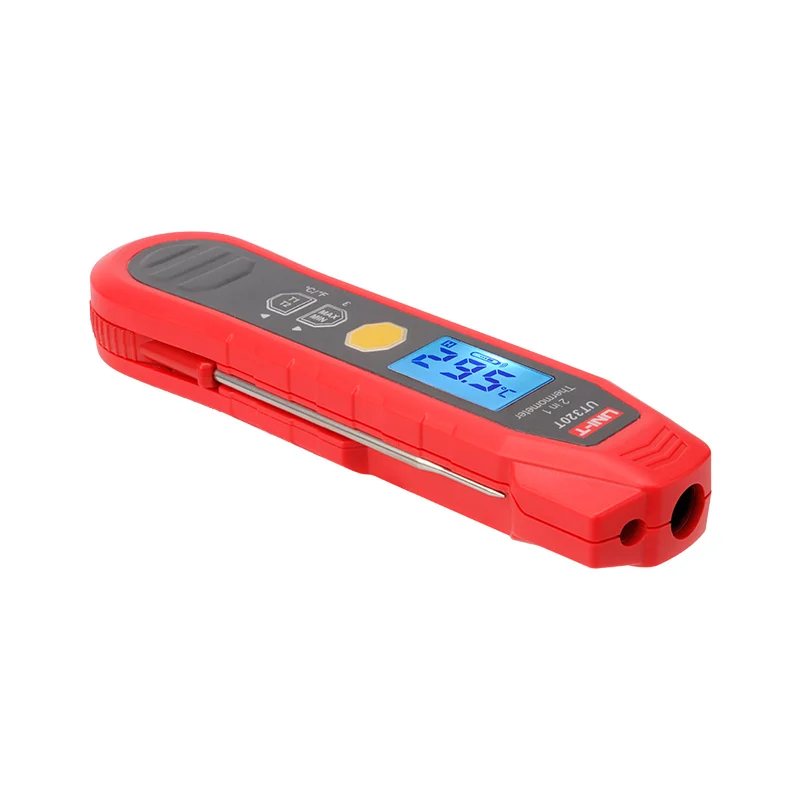
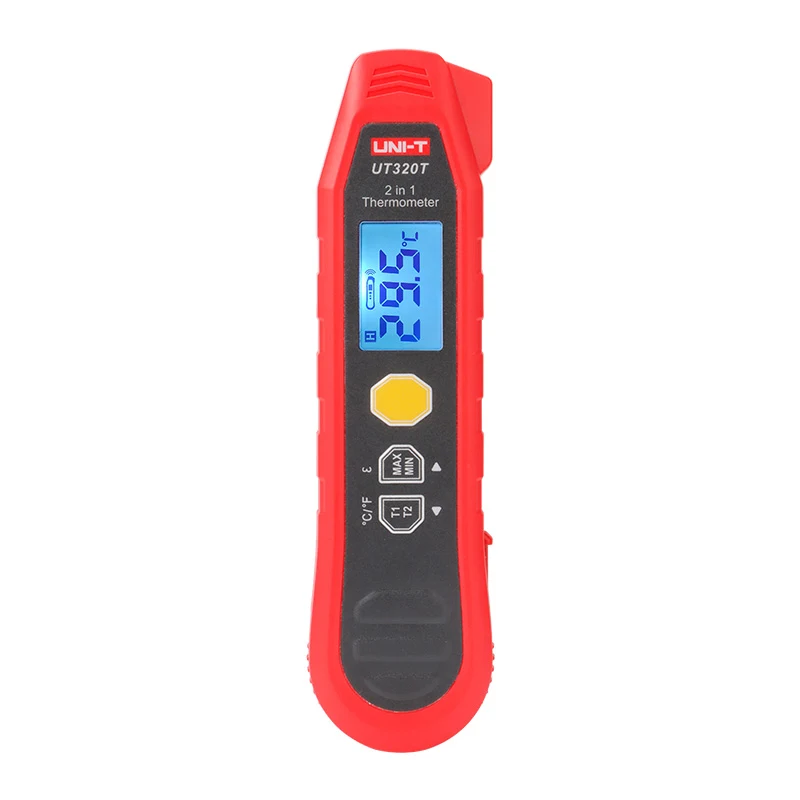
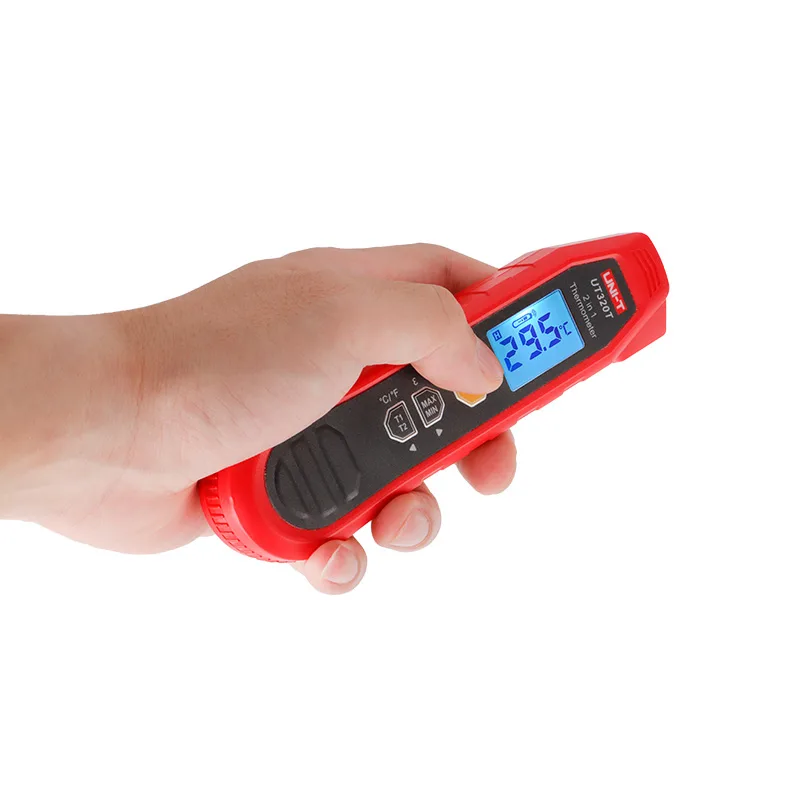
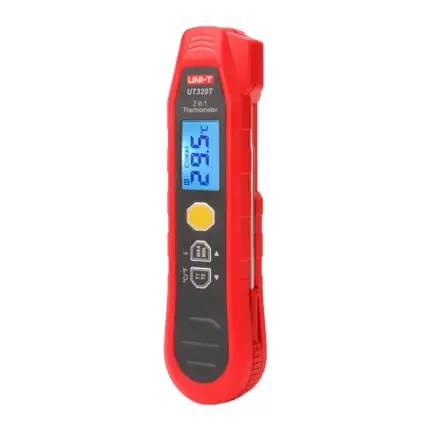
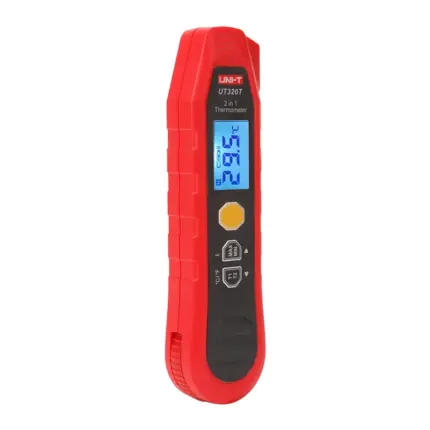
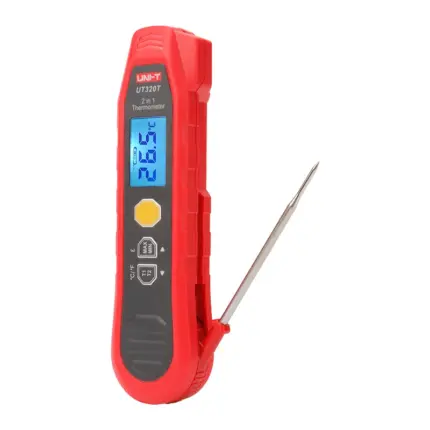
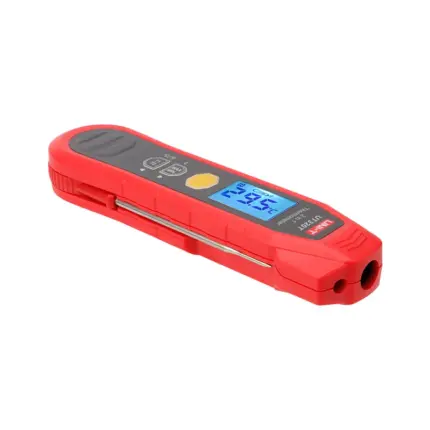
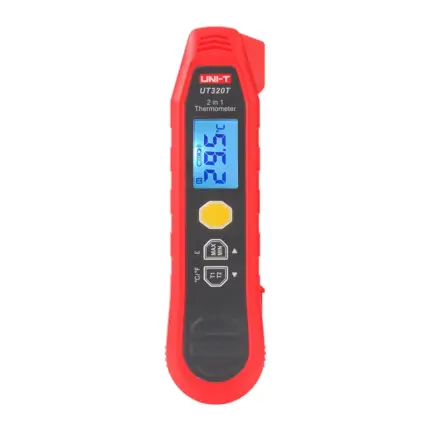
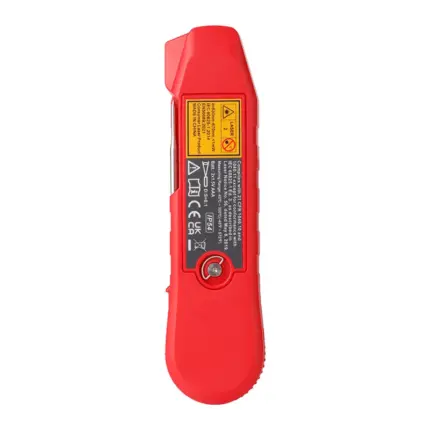
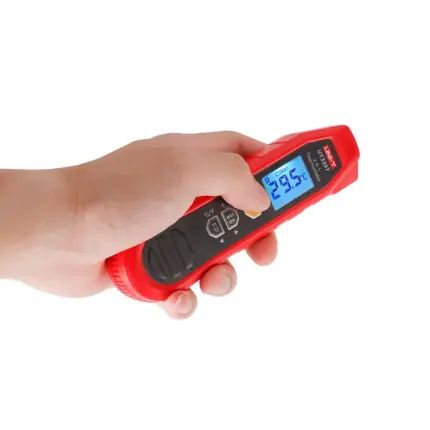
UNI-T UT320T 2-in-1 Thermometer | Non-Contact Infrared Surface Scanner, 180° Collapsible NTC Probe and Adjustable Emissivity Matrix
The UNI-T UT320T 2-in-1 Thermometer is a high-precision, industrial-grade diagnostic instrument engineered to combine surface infrared laser scanning with direct immersion probe tracking into a single compact housing. This dual-mode setup allows service technicians, field engineers, and quality inspectors to capture surface temperatures instantly or pivot to internal core measurements.
[fluentform id="1"]
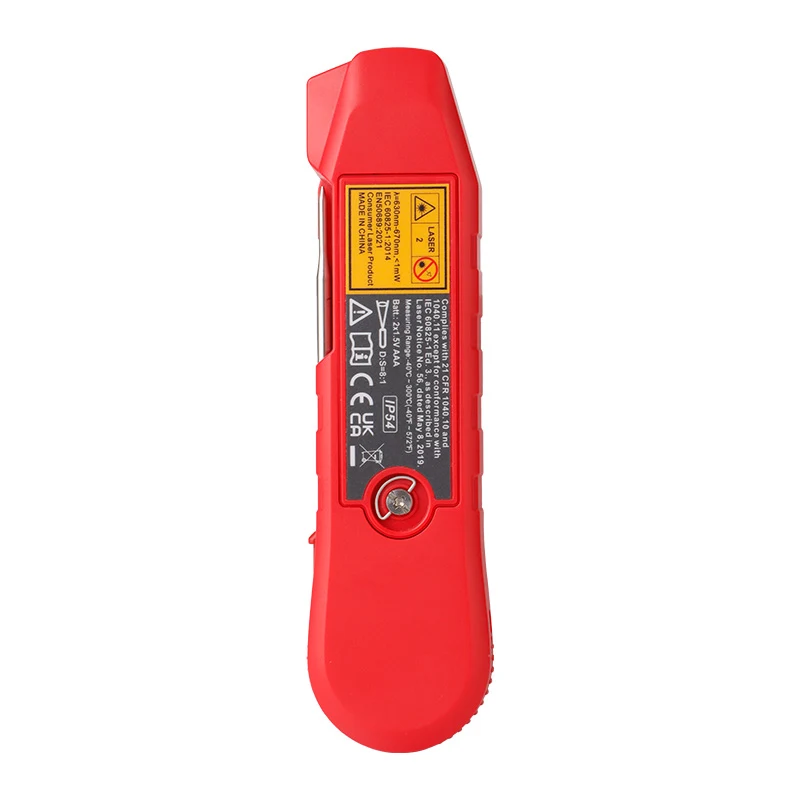
Built to withstand demanding job sites, the UNI-T UT320T features an IP54-rated ingress barrier and heavy-duty shock absorption, making the instrument an essential tool for refrigeration diagnostics, HVAC/R air conditioning servicing, automotive maintenance, and facility construction validation.
Why the UNI-T UT320T Should Be Used & Preferred
Unified Dual-Measurement System:
Field operators can eliminate the cost and clutter of carrying standalone laser guns and digital pocket needles. The integrated infrared sensor captures ambient surface energy in milliseconds, while the heavy-duty fold-out metal needle deploys smoothly to execute submersion tests in liquids or internal diagnostics.
True Multi-Material Accuracy:
Unlike entry-level infrared guns that produce flawed readings on reflective metal pipes or machinery due to fixed emissivity limitations, the UNI-T UT320T features fully adjustable emissivity settings ranging from 0.1 to 1.0. Technicians can fine-tune the sensor profile to match different material properties exactly, ensuring factual data capture.
Extreme Environmental Survival:
Built specifically for challenging workspaces, the thermometer features rugged physical defense properties, including a certified 2-meter drop-proof rating and an IP54 dust and splash-proof seal. These protection characteristics shield the internal micro-circuits from sudden impacts, pipe leaks, and dusty ventilation shafts.
Advanced Real-Time Calculations:
The internal processing architecture automates field differential calculations on the spot. With a quick button sequence, users can lock target readings, isolate maximum and minimum peaks, or display T1-T2 temperature variance to gauge system efficiency.
Measurement Specifications
| Diagnostic Mode | Parameter Profile | Technical Range & Performance Limits |
|---|---|---|
| System-Wide | Overall Temperature Span | -40°C to 300°C (-40°F to 572°F) |
| Infrared Path | Distance-to-Spot (D:S) | 8 : 1 optical focus ratio |
| Emissivity Adjustments | Variable calibration from 0.1 to 1.0 | |
| Spectral Range Band | 5μm to 14μm | |
| Laser Aiming Profile | Class 2, single laser pointer (<1mW power output at 650 ±20nm) | |
| Response Frequency | ≤ 500 ms (captures 95% of real-time thermal curve) | |
| Probe Path | Contact Sensor Core | Negative Temperature Coefficient (NTC) architecture |
| Minimum Measuring Depth | 12.7 mm minimum insertion standard |
Core Device Features
- 01
Integrated Data Hold & Lock
Freezes the current calculation value on the screen or locks the active logging path, allowing operators to safely document readings away from hot engine bays or high-voltage panels.
- 02
Max/Min Real-Time Peak Logging
Tracks and isolates the absolute maximum and minimum thermal peaks encountered during a continuous testing cycle, simplifying systemic performance checks.
- 03
Instant Unit Conversion
Converts active data strings between Celsius (°C) and Fahrenheit (°F) seamlessly via a dedicated interface control.
- 04
Automated Power Management
Incorporates a smart 10-minute auto-power-off utility that automatically powers down the hardware to protect active battery cells from accidental drain.
General & Mechanical Characteristics
- LCD Screen Specifications: Equipped with an 18mm x 28mm high-contrast FSTN-type liquid crystal display backed by a crisp integrated backlight for readability in unlit utility crawlspaces.
- Enclosure Material Profile: Built with a pocket-friendly, compact structure featuring certified IP54 splash resistance and a verified 2-meter drop-proof outer frame.
- Physical Device Dimensions: Slim-profile chassis configuration measuring 155mm x 42mm x 22.5mm.
- Net Tool Weight: Balanced construction weighing approximately 110g when fully loaded with power cells.
- Power Supply and Operational Times: Driven by 2 standard 1.5V AAA batteries, yielding approximately 30 hours of continuous active use in infrared mode (with laser and backlight fully engaged) or up to 180 hours in contact probe mode.
- Manufacturing Standards: Officially marked with global CE and UKCA safety compliance certifications.
Advantages Over Nearest Competitors
Fully Variable Emissivity Scaling:
Most competitive pocket infrared thermometers restrict users to a fixed emissivity baseline of 0.95, resulting in inaccurate readings on polished metal pipes and alloy components. The UNI-T UT320T provides complete manual adjustment scaling from 0.1 to 1.0, enabling accurate multi-surface auditing.
Superior 2-Meter Shock Absorption:
While entry-level tester pens often crack or lose sensor calibration from a simple desktop drop, the UNI-T UT320T features an upgraded structural frame built to survive 2-meter impacts onto concrete floor surfaces without interrupting operational paths.
Extended Energy Efficiency Path:
Optimized engineering gives the UNI-T UT320T a substantial power advantage, providing up to 180 hours of continuous contact logging on standard AAA cells. This eliminates the premium costs and sudden field failures associated with budget models that drain button cells or proprietary batteries rapidly.
Did You Know?
What is Adjustable Emissivity Matrix?
An Adjustable Emissivity Matrix (often referred to as adjustable emissivity calibration) is a software and hardware integration found in advanced infrared thermometers like the UNI-T UT320T. It allows the operator to manually modify the sensor's radiation scaling factor to accurately calculate the temperature of different material surfaces.
To understand why this is a critical tool for industrial measurement, it helps to look at the physics of thermal radiation.
🔍 The Science of Emissivity
Every physical object emits infrared energy based on its temperature. Emissivity is a measurement ratio (scaled between 0.1 and 1.0) that determines how efficiently a surface radiates that infrared energy compared to a perfect theoretical absorber (a "blackbody," which has a value of 1.0).
High Emissivity (~0.95): Matte, rough, or organic surfaces (like wood, rubber, dark plastic, soil, or human skin) release infrared energy very efficiently.
Low Emissivity (<0.30): Polished, shiny, or bare metal objects (such as copper pipes, stainless steel vats, and aluminum heat sinks) reflect external ambient heat rather than emitting their own.
⚠️ The Problem with Fixed Instruments
Most standard consumer infrared thermometers are permanently locked to a fixed emissivity baseline of 0.95.
If a technician shoots a fixed-emissivity laser gun at a shiny, hot copper HVAC pipe, the raw reflection off the metal surface tricks the optical sensor into calculating a reading that can be dozens of degrees lower than the physical reality. This error can cause technicians to misdiagnose dangerous system overloads or faulty cooling lines.
🛠️ How the Adjustable Matrix Fixes the Error
An adjustable instrument allows the technician to change the reference numerical parameter directly on the device display to match the target material's exact physical coefficient profile:
- 1Step 1: The user references a standard industrial material chart (e.g., Polished Copper = 0.05, Cast Iron = 0.80, Rubber = 0.95).
- 2Step 2: The user enters that exact matching value into the digital calibration screen.
- 3Step 3: The thermometer's internal processor applies a mathematical matrix calculation to the incoming infrared energy waves. This filters out surrounding ambient reflections and amplifies the true wave energy emitted by the metal, delivering a factual temperature readout.
🌟 Key Field Benefits
Prevents False HVAC Diagnostics:
Allows precise tracking of metallic coolant lines, condenser coils, and compressor bodies.
Multi-Surface Versatility:
A single hand tool can instantly pivot from checking matte black engine hoses (0.95) to raw aluminum blocks (0.30) with a simple software setting adjustment.
Industrial Compliance Safety:
Ensures that high-temperature factory infrastructure, steam valves, and electrical switchgear are safely monitored before mechanical breakdown occurs.