
- Actuators
- Adapters
- Air Blowers
- Air Conditioners
- Air Curtains
- Air Purifiers
- Anemometers
- Axial fans
- Ball Valves
- Belimo
- Blowers
- Brackets
- Brass
- Brazing Rods
- Capacitors
- Carrier Parts
- Clamp Meters
- Cleaning Products
- Coatings
- Compressors
- Condensate Pumps
- Connectors
- Contactors
- Copper Capillary
- Copper Coils
- Copper Straight Tubes
- Copper Strainers
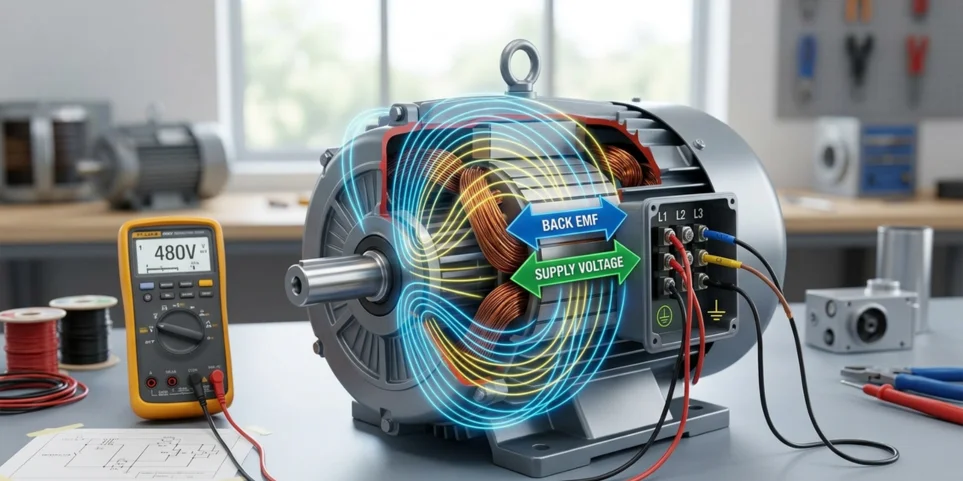
Why Back-EMF Matters in HVAC and Motors

Why Back-EMF Matters in HVAC and Motors
Back-EMF is critical for both the protection and control of electrical systems:
- Natural Speed Governor: If a motor slows down because it is overworked (loaded heavily), the back-EMF drops. This allows more incoming current to enter the motor, providing the extra torque needed to pull the heavy load. Conversely, if the load is removed, the motor speeds up, back-EMF rises, and the current drops.
- Motor Burnout Risks: If a compressor or fan motor gets mechanically jammed and cannot spin, back-EMF remains at zero. The motor will continuously pull maximum LRA current, rapidly overheating and burning out the windings unless a safety relay trips.
- Contactor Arc Flashes: When an HVAC contactor opens to turn off a compressor, the sudden collapse of the motor’s magnetic field creates a massive spike of back-EMF. This voltage spike jumps across the separating metal points, creating a visible electrical arc that wears out the contactor over time.
How to Protect HVAC Motors from Missing Back-EMF (Startup Stress)
Because back-EMF is zero at a complete standstill, motors experience extreme electrical and mechanical stress during startup.
- HVAC Soft Starters: A soft starter temporarily reduces the incoming voltage right when the compressor turns on. It gradually ramps up the power, keeping the startup current (LRA) low until the motor spins fast enough to generate its own protective back-EMF.
- Variable Frequency Drives (VFDs): VFDs continuously match the supplied voltage and frequency to the exact speed of the motor. This ensures the motor is never forced to pull high current without an equivalent amount of back-EMF protecting it.
- Hard Start Kits (Start Capacitors): For single-phase AC compressors, a hard start kit uses a high-capacity capacitor and a potential relay to force the motor to spin up to full speed much faster. Minimizing the time the motor spends at zero back-EMF drastically reduces the duration of the startup heat spike.
How to Prevent HVAC Motor Windings Burnout (Overload Protection) from Missing Back-EMF
If a motor jams mechanically, back-EMF drops to zero while it is running, causing it to pull continuous LRA.
- Thermal Overload Relays: These safety devices monitor the actual running amperage. If the current spikes because back-EMF has dropped, the thermal element heats up and trips the contactor coil, cutting power before the motor windings melt.
How to Prevent Compressor Motors’ Damage from Missing Back-EMF
Kriwan motor protectors indirectly prevent damage from missing back-EMF. They do this by continuously monitoring the severe symptoms that occur when a motor operates without its protective back-EMF.
A standard Kriwan protection module (such as the industry-standard INT69 series used across Copeland, Bitzer, and Frascold compressors) is designed as a core thermal and phase monitoring system.
Kriwan units mitigate the consequences of zero or missing back-EMF in three key ways:
1. Handling Zero Back-EMF at Standstill (Locked Rotor / Stalled State)
When an HVAC compressor tries to start but is mechanically jammed (liquid slugging, bad bearings, or internal failure), it cannot turn. Because there is no motion, back-EMF is completely missing. The motor pulls maximum Locked Rotor Amps (LRA), causing an instantaneous, violent thermal spike inside the internal copper windings.
- The Kriwan Response: Kriwan modules do not read line current directly; instead, they monitor a daisy-chained string of PTC (Positive Temperature Coefficient) thermistors embedded directly inside the motor windings. If back-EMF is missing and the temperature climbs, the PTC resistance spikes instantly. The Kriwan INT69 detects this change and opens its control contact, cutting power to the main compressor contactor within milliseconds to prevent a total blowout.
2. Monitoring Dynamic Temperature Rises (Overload States)
If a running motor experiences an extreme load drop in speed, its generated back-EMF falls proportionally. Less back-EMF means the incoming current automatically surges, generating rapid heat buildup.
- The Kriwan Response: Modern modules, like the Kriwan INT69 Diagnose, feature dynamic temperature monitoring. If the internal processor catches a steep, mathematical climb in winding temperature—even if the overall temperature has not hit the final threshold yet—it proactively trips. This limits prolonged thermal stress caused by low back-EMF scenarios.
3. Preventing Reverse Rotation (Phase Monitoring)
In three-phase scroll compressors, if power lines are wired backward, the motor spins in reverse. Running backward alters internal cooling mechanics (especially refrigerant suction cooling gas flow), leading to a rapid loss of thermal regulation alongside altered electromotive counter-forces.
- The Kriwan Response: Advanced diagnostic variants (like the INT69 Y Diagnose) actively check the phase sequence. If it detects incorrect rotation or a missing phase (which destroys the balancing voltage/back-EMF ratio), it locks out the compressor within 5 seconds before damage can occur.
Comparison: Standard Overload Relay vs. Kriwan Protector for Compressor Motors
| Protection Device | How it Senses Faults | Reaction to Missing Back-EMF |
| Standard Thermal Overload Relay | Measures line current at the external panel block. | Trips when external current remains above set FLA for too long. |
| Kriwan INT69 Module | Measures true temperature inside the compressor motor windings. | Trips much faster because it directly gauges internal heat, ignoring external cooling variables. |