

- Actuators
- Adapters
- Air Blowers
- Air Conditioners
- Air Curtains
- Air Purifiers
- Anemometers
- Axial fans
- Ball Valves
- Belimo
- Blowers
- Brackets
- Brass
- Brazing Rods
- Capacitors
- Carrier Parts
- Clamp Meters
- Cleaning Products
- Coatings
- Compressors
- Condensate Pumps
- Connectors
- Contactors
- Copper Capillary
- Copper Coils
- Copper Straight Tubes
- Copper Strainers
differences between Star Y and Delta Connections

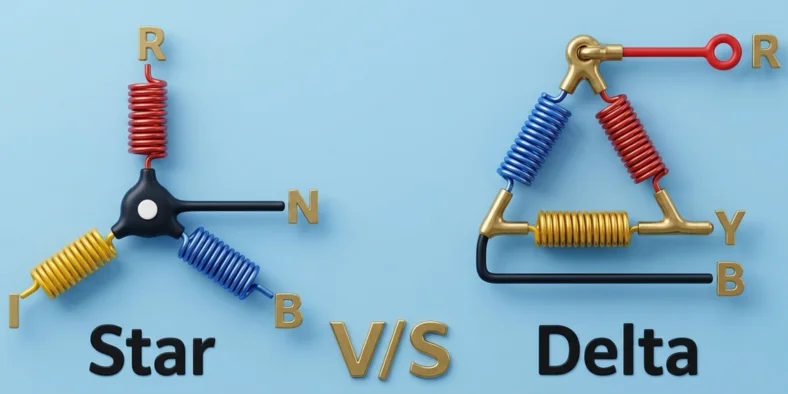
What are the differences between Star Y and Delta Connections?
The main difference between Star (Y) and Delta (∆) connections is that a Star connection uses four wires (three phases and a neutral) with a shared central point, while a Delta connection uses three wires (three phases only) forming a closed loop.
Star connections are ideal for long-distance distribution and running everyday appliances because they provide two different voltages. Delta connections are primarily used for industrial applications and high-power machinery because they can deliver high starting torque.
Summary of Key Differences
| Feature | Star (Y) Connection | Delta (∆) Connection |
| Shape | Y-shape | Triangle (∆) shape |
| Number of Wires | 4 wires (3 Phases + 1 Neutral) | 3 wires (3 Phases only) |
| Neutral Point | Present | Absent |
| Insulation Level | Lower (handles lower phase voltage) | Higher (handles full line voltage) |
| Common Use | Power distribution & domestic loads | Power transmission & industrial motors |
Circuit Configuration and Geometry
- Star Connection: The endings of all three coils are connected to a single common node. This central junction acts as the neutral point (N). The remaining three open ends form the phase lines (L_1, L_2, L_3)
- Delta Connection: The finish terminal of one coil is connected to the start terminal of the next coil. This continuous serial connection creates a closed triangular loop, with the three phase lines tapped from the vertices.
Application and System Behavior
- Star Application: Used at the distribution end (homes and offices). The neutral wire handles unbalanced loads. If one phase fails, the other two continue functioning normally.
- Delta Application: Used in high-power industrial environments and distribution transformers. It requires less insulation for a given power level because the phase voltage is not multiplied. However, an unbalanced load can create dangerous circulating currents within the mesh loop.
Comparison Summary
The core difference lies in the presence of a neutral wire and how voltage and current split. Star networks are highly flexible for mixed single-phase and three-phase domestic distribution, while Delta networks provide efficient, heavy-duty power for industrial transmission and motor machinery.
Did you know?
When it comes to axial fans, the main difference between Star Y and Delta (Δ) is torque, which is caused by the difference in voltage applied to each motor winding.
Because an axial fan requires more torque as it speeds up, this difference significantly impacts how the fan operates.
1. The Voltage-Torque Connection
The torque a motor produces is directly proportional to the square of the voltage it receives.
- Star (Y): Receives 58% of line voltage. Torque drops to 33%.
- Delta (Δ): Receives 100% of line voltage. Torque is at 100%.
2. How This Affects the Axial Fan
Axial fans have a “quadratic” load profile. This means the torque needed to turn the blades increases drastically as the fan spins faster.
- In Star Mode: The motor has low torque. It is only strong enough to start the fan and spin it at low speeds. If you try to run the fan continuously in Star at full load, the motor will overheat and trip because it lacks the torque to overcome the air resistance.
- When a motor is wired in Star Y connection:
- Voltage across each winding drops to about 58% (1 ÷ √3) of the full line voltage.
- Starting Current is reduced to one-third of its normal rating.
- Torque is reduced to 33% of the motor’s total capacity.
- Result on Fan Speed: Because the fan load starts out relatively light, the motor will still spin, but it may struggle to accelerate or can stall if the fan is heavily loaded. If left running in Star, the motor delivers much less power.
- In Delta Mode: The motor delivers 100% torque. It easily overcomes the air resistance, maintains the rated speed, and moves the full volume of air.
- When wired in Delta:
- Voltage across each winding is equal to the full line voltage.
- Torque and Power are at their maximum rated values.
- Result on Fan Speed: The motor operates at its full operational capacity, easily driving the axial fan to its rated RPM and maintaining the required airflow
3. The Secondary Difference: Current (electrical difference)
While torque is the mechanical difference, current (amperage) is the electrical difference.
- Star draws 33% of the starting current compared to Delta.
- This makes Star perfect for the first few seconds of starting the fan to protect your electrical grid from power dips.
Summary
- Star = Low Torque / Low Current (Used only to get the heavy fan blades moving safely).
- Delta = Full Torque / Full Current (Used for normal, continuous fan operation).