

- Actuators
- Adapters
- Air Blowers
- Air Conditioners
- Air Curtains
- Air Purifiers
- Anemometers
- Axial fans
- Ball Valves
- Belimo
- Blowers
- Brackets
- Brass
- Brazing Rods
- Capacitors
- Carrier Parts
- Clamp Meters
- Cleaning Products
- Coatings
- Compressors
- Condensate Pumps
- Connectors
- Contactors
- Copper Capillary
- Copper Coils
- Copper Straight Tubes
- Copper Strainers
Deburr vs Chamfer

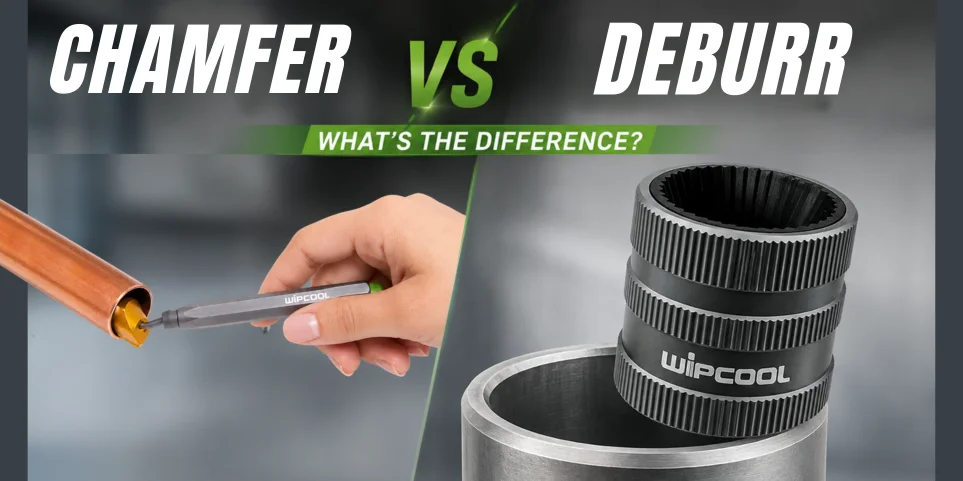
Deburring vs Chamfering
Why is Copper Tube Deburring Needed When Installing an Air Conditioner
Copper tube deburring (burring) is necessary because cutting a pipe with a wheel tube cutter leaves a sharp metal lip that shrinks the inner diameter, disrupts refrigerant and oil flow, creates destructive turbulence, risks tearing flare connections and leaves loose metal shavings that can ruin the compressor.
Why Deburring is Essential on Copper Pipes
- Prevents System Blockages & Damage: Shavings or sharp metal flakes left inside the tube can circulate with the refrigerant and wreck the air conditioner’s compressor.
- Stops Refrigerant Turbulence: A jagged internal edge acts like a speed bump, creating turbulent flow that causes noise, drops system efficiency, and disrupts proper compressor oil return.
- Ensures Leak-Free Flares: If you are flaring the tube to connect it to service valves, a rough edge can scratch or split the flare face, causing costly refrigerant leaks.
- Improves Welds (Brazing): Removing outside and inside burrs allows pipes to slide together smoothly for a tight, uniform fit before applying silver solder or brazing alloy.
What is a Chamfer?
Chamfering is the process of cutting away a sharp edge or corner to create a flat, angled slope (typically 45 degrees) between two surfaces.
Instead of leaving a sharp 90-degree corner, chamfering creates a neat, transitional bevel.
Why Chamfering is Used on Metal Pipes
- Removes Sharp Burrs: In piping and machining, it shaves off the hazardous, razor-sharp edges left behind after cutting metal or plastic.
- Allows Easier Assembly: It acts like a guide ramp. An outer chamfer on a tube allows it to slide effortlessly into a fitting, coupling, or expander block without catching.
- Protects Hands and Parts: It smooths down sharp external edges, preventing installers from cutting their hands and stopping metal parts from scratching each other.
- Prevents Stress Cracks: Removing sharp corners distributes mechanical stress more evenly, making materials less likely to crack or chip under pressure.
Differences Between Deburring & Chamfering
While technicians often use the terms interchangeably on the job, deburring focuses on removing loose, unwanted metal debris, whereas chamfering involves cutting a precise, angled shape into the pipe edge.
| Deburring | Chamfering | |
|---|---|---|
| Primary Goal | Removes rough, irregular metal ridges (burrs) left behind after cutting. | Cuts a clean, deliberate, symmetrical 45° angle on the pipe edge. |
| Location on Tube | Crucial for the inside of the tube. | Applied primarily to the outside edge. |
| Why it Matters | Prevents inner turbulence that causes noise. Removes metal shavings or flakes that cause system blockages. | Prevents the sharp outer lip from cutting rubber O-rings inside push-to-connect fittings. |
Why the Distinction Matters for Plumbing & HVAC
- Internal Deburring: When you cut copper pipe with a wheel cutter, the tool naturally forces a tiny ridge of metal inward. Leaving this inner burr intact acts like a small speed bump, disrupting flow and causing erosion-corrosion or system inefficiency.
- External Chamfering: Creating that outside bevel is critical for push-fit or press-fit installations. Without a smooth chamfer, the square, razor-sharp edge of freshly cut copper can score or tear the internal rubber seal, leading to an immediate leak.
Our WIPCOOL tools make it easy for professionals to get clean deburrs and precise chamfers on any metal tube.