

- Actuators
- Adapters
- Air Blowers
- Air Conditioners
- Air Curtains
- Air Purifiers
- Anemometers
- Axial fans
- Ball Valves
- Belimo
- Blowers
- Brackets
- Brass
- Brazing Rods
- Capacitors
- Carrier Parts
- Clamp Meters
- Cleaning Products
- Coatings
- Compressors
- Condensate Pumps
- Connectors
- Contactors
- Copper Capillary
- Copper Coils
- Copper Straight Tubes
- Copper Strainers
What does Silver Cadmium Oxide do in electrical contacts?

What does Silver Cadmium Oxide do in electrical contacts?
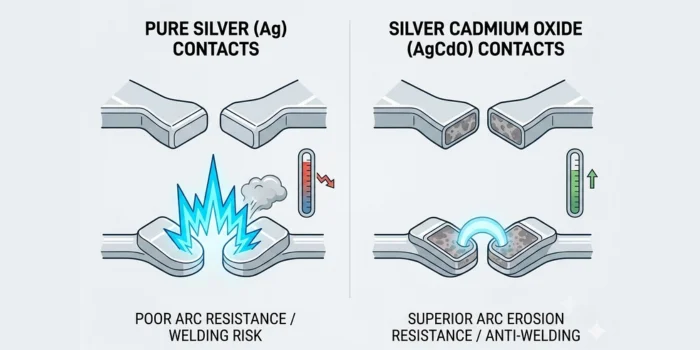
In electrical contacts, Silver Cadmium Oxide (AgCdO) acts as a high-performance compound that prevents contact failure by combining the superb conductivity of silver with the arc-extinguishing and anti-welding properties of cadmium oxide. It is often referred to as a “universal contact material” for low-to-medium voltage switchgear, relays, and contactors.
Key Functions of Cadmium Oxide
- Prevents Contact Welding: Under high current or short-circuit conditions, intense heat can cause mating contacts to melt and fuse together. As temperature rises, cadmium oxide vaporizes endothermically (absorbing heat), which cools the contact surface and violently disrupts the formation of a liquid metal bridge, effectively preventing the contacts from sticking or welding.
- Extinguishes and Resists Arcing: Every time electrical contacts open or close under a load, electricity arcs across the gap. Cadmium oxide enhances resistance to arc erosion, blowing the arc out faster and minimizing material loss and uneven material transfer across the contact faces.
- Maintains Low Contact Resistance: Pure silver oxidizes and sulfidates over time. The localized arcing across a silver cadmium oxide contact burns away these film impurities, maintaining low and stable interface resistance for clean current transmission.
- Improves Mechanical Hardness: Dispersing microscopic CdO particles within the matrix mechanically hardens the contact surface. This dramatically increases resistance to mechanical wear and deformation from millions of physical “make-and-break” cycles.