
- Actuators
- Adapters
- Air Blowers
- Air Conditioners
- Air Curtains
- Air Purifiers
- Anemometers
- Axial fans
- Ball Valves
- Belimo
- Blowers
- Brackets
- Brass
- Brazing Rods
- Capacitors
- Carrier Parts
- Clamp Meters
- Cleaning Products
- Coatings
- Compressors
- Condensate Pumps
- Connectors
- Contactors
- Copper Capillary
- Copper Coils
- Copper Straight Tubes
- Copper Strainers
What do poles in air conditioning contactors mean?

What do poles in air conditioning contactors mean?
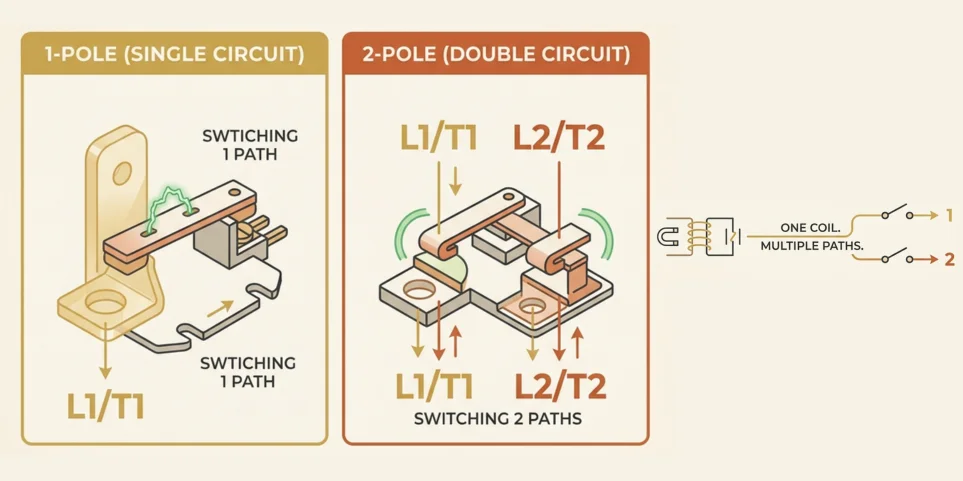
In an air conditioning contactor, “poles” refer to the number of separate high-voltage electrical paths (or circuits) that the contactor can safely open or close simultaneously.
While poles in a motor determine speed, poles in a contactor determine how many wires are physically disconnected when the thermostat tells the system to shut off.
Common Contactor Pole Types in HVAC
| Contactor Type | Main Characteristic | Common HVAC Use Case |
| 1-Pole (Single Pole) | One line opens; one line stays constantly connected via a solid brass bypass bar. | Residential outdoor condenser units (common factory standard). |
| 2-Pole (Double Pole) | Both lines open; completely breaks the circuit on both hot legs when shut off. | Premium replacement for residential ACs and standard electric heat strips. |
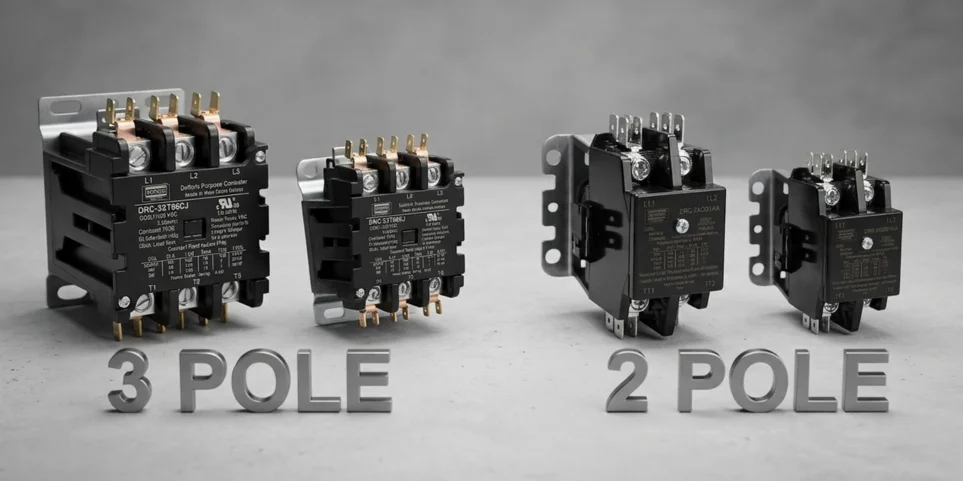
| 3-Pole (Triple Pole) | Three lines open; simultaneously switches all three hot legs of electricity. | Commercial HVAC systems running on heavy-duty 3-phase power. |
Deep Dive: 2-Pole Contactors
A 2-pole contactor features two internal sets of high-voltage switches that move together.
- How it works: When your home thermostat calls for cooling, a 24V coil magnetizes and pulls down a bridge, simultaneously closing both hot legs of the incoming 240V residential power supply.
- Safety Advantage: Unlike a factory-standard 1-pole contactor (which leaves one power leg permanently live), a 2-pole contactor completely isolates the outdoor unit from electricity when it shuts off.
- Compatibility: It cannot be used to run 3-phase commercial motors because it lacks the third terminal needed to complete the rotating magnetic field.
Deep Dive: 3-Pole Contactors
A 3-pole contactor features three isolated high-voltage switches housed inside a single wider plastic body.
- How it works: Commercial buildings use three-phase power, where three separate alternating current waves are delivered out of step with one another. The 3-pole contactor closes all three of these active power lines at the exact same millisecond.
- Interchangeability Trick: If a technician is in a pinch during a residential emergency repair, a 3-pole contactor can temporarily replace a 2-pole contactor. The technician simply wires into two of the three available poles (leaving the center or side pole completely empty).
- The Reverse is Impossible: A 2-pole contactor can never be used in place of a 3-pole contactor. Attempting to do so leaves one phase unswitched, which will instantly destroy a three-phase compressor through a catastrophic electrical failure called “single-phasing.”
Summary
In an HVAC contactor, the pole count dictates the number of separate electrical lines the switch can break. For standard 240V residential AC systems, a 1-pole contactor switches one wire, while a 2-pole contactor switches both wires.
Our PETROSS contactors with silver cadmium oxide contacts come in either 2 pole or 3 pole configurations.
Use a PETROSS 2-pole contactor if you are working on a standard residential home air conditioner.
Use a PETROSS 3-pole contactor if you are servicing a commercial building package unit.