

- Actuators
- Adapters
- Air Blowers
- Air Conditioners
- Air Curtains
- Air Purifiers
- Anemometers
- Axial fans
- Ball Valves
- Belimo
- Blowers
- Brackets
- Brass
- Brazing Rods
- Capacitors
- Carrier Parts
- Clamp Meters
- Cleaning Products
- Coatings
- Compressors
- Condensate Pumps
- Connectors
- Contactors
- Copper Capillary
- Copper Coils
- Copper Straight Tubes
- Copper Strainers
What do the poles on air conditioning motors mean?

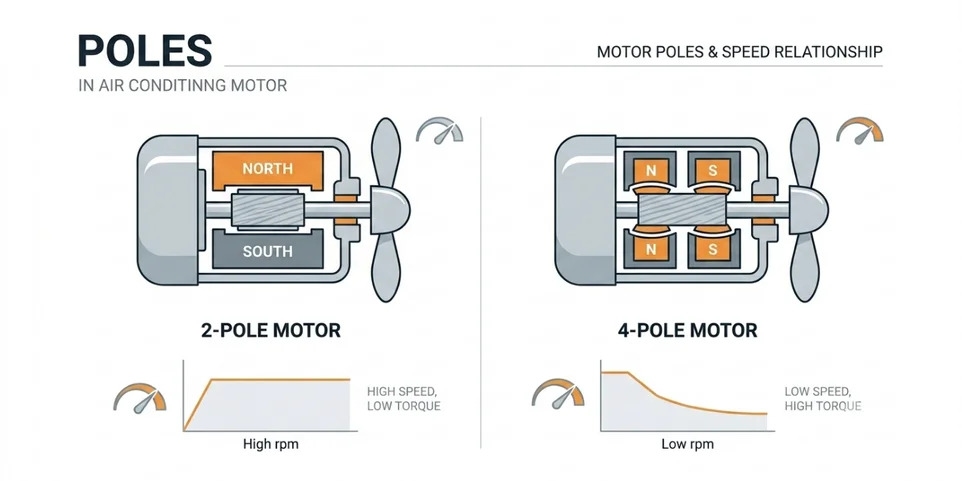
What do the poles on air conditioning motors mean?
In an air conditioning motor, “poles” refer to the magnetic poles (North and South pairs) built into the motor’s stator windings. The number of poles directly determines the operating speed (RPM) and torque characteristics of the motor.
Because AC motors rely on the alternating frequency of your electricity supply (usually 60 Hz in North America or 50 Hz in the UAE), the poles act like gears: the more poles a motor has, the slower it spins, but the more torque it produces.
Why Pole Count Matters in HVAC
- Airflow and Speed Control: The physical speed of an AC motor dictates how much air or refrigerant it moves. For instance, a 4-pole motor is ideal for an outdoor condenser fan because it efficiently pushes high volumes of air without creating excessive blade noise.
- Noise and Vibration: Higher pole counts (like 6-pole or 8-pole configurations) offer much smoother magnetic transitions. This drastically reduces the ambient hum, vibration, and mechanical noise inside your living space.
- Torque Capabilities: Applications that require a heavy initial push—like starting a compressor packed with dense refrigerant liquid—rely on lower speeds paired with the heavy-duty torque provided by multi-pole structures.