

- Actuators
- Adapters
- Air Blowers
- Air Conditioners
- Air Curtains
- Air Purifiers
- Anemometers
- Axial fans
- Ball Valves
- Belimo
- Blowers
- Brackets
- Brass
- Brazing Rods
- Capacitors
- Carrier Parts
- Clamp Meters
- Cleaning Products
- Coatings
- Compressors
- Condensate Pumps
- Connectors
- Contactors
- Copper Capillary
- Copper Coils
- Copper Straight Tubes
- Copper Strainers
Flash Point vs Pour Point of Oil

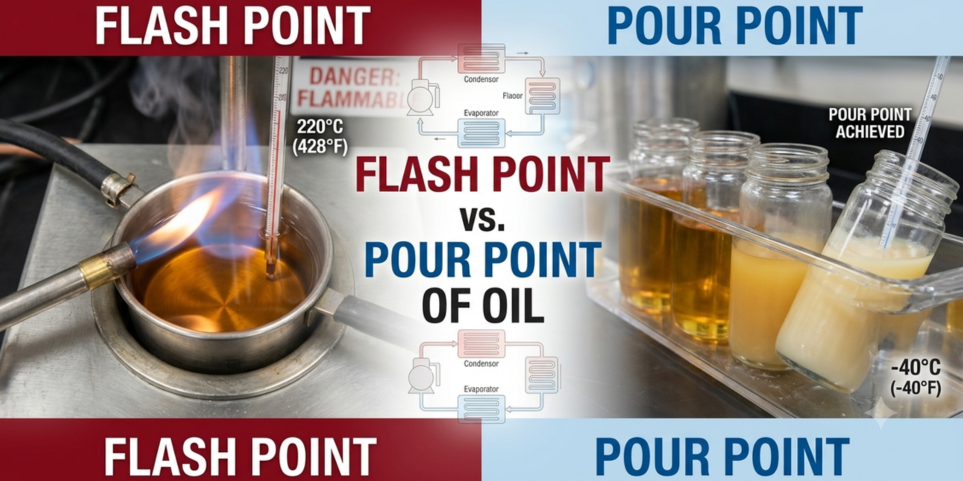
Flash Point vs Pour Point of Oil
While the flash point measures an oil’s fire hazard safety, the pour point measures its low-temperature flowability.
Here is the direct comparison between the two metrics:
Flash Point vs. Pour Point of Oil
| Feature | Flash Point of Oil | Pour Point of Oil |
| What it measures | High-temperature safety limit. | Low-temperature operating limit. |
| Definition | Lowest temperature where oil produces ignitable vapors. | Lowest temperature where oil continues to pour/flow before freezing or gelling. |
| Risk identified | Fire, explosion, and fuel contamination. | Engine starvation, clogged filters, and pumping failure. |
| Physical state | Vaporizes into gas. | Solidifies or forms wax crystals. |
Why Both Matter Together
Engineers and technicians look at both numbers to define the safe operating window of a machine:
- The Lower Limit (Pour Point): If a vacuum pump machine operates below the oil’s pour point, the oil turns into a thick gel. The oil pump cannot move it, leading to dry metal-on-metal friction and immediate vacuum pump failure.
- The Upper Limit (Flash Point): If a vacuum pump machine runs too hot and approaches the flash point, the oil degrades rapidly and creates a severe fire risk.