- Actuators
- Adapters
- Air Blowers
- Air Conditioners
- Air Curtains
- Air Purifiers
- Anemometers
- Axial fans
- Ball Valves
- Belimo
- Blowers
- Brackets
- Brass
- Brazing Rods
- Capacitors
- Carrier Parts
- Clamp Meters
- Cleaning Products
- Coatings
- Compressors
- Condensate Pumps
- Connectors
- Contactors
- Copper Capillary
- Copper Coils
- Copper Straight Tubes
- Copper Strainers
Superheat in Air Conditioning

Superheat in Air Conditioning
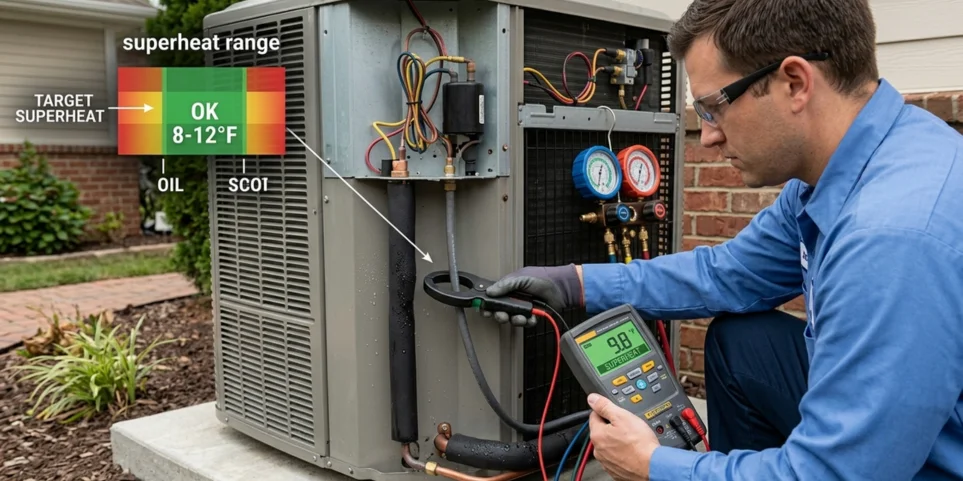
In air conditioning, superheat is the number of degrees a refrigerant vapor is heated above its saturation temperature (boiling point). It measures the sensible heat gained by the refrigerant after it has fully transitioned from a liquid into a 100% vapor state inside the indoor evaporator coil.
The Formula
To calculate superheat, HVAC technicians measure both the pressure and temperature simultaneously on the suction line:
Superheat = Actual Suction Line Temperature – Saturation Temperature (Boiling Point)
- Actual Temperature: Measured using a physical temperature clamp on the copper suction pipe.
- Saturation Temperature: Found by reading the suction pressure on a gauge manifold and converting it to temperature using a pressure-temperature (P-T) chart.
Why Superheat Matters
Monitoring superheat is critical for diagnosing system health and ensuring optimal performance:
- Compressor Protection: Air conditioning compressors are strictly designed to pump vapor, not liquid. Superheat acts as a safety buffer ensuring all liquid has safely boiled off before entering the compressor.
- System Efficiency: A proper superheat level (typically 8°F to 14°F for standard residential systems) confirms the evaporator coil is making full use of its surface area to cool your home.
Diagnosing Issues Using Superheat
- Low Superheat (Under 5°F): The evaporator coil is “flooded” with too much liquid refrigerant. This risks sending liquid back to the compressor (known as liquid slugging), which can permanently destroy the valves and wash away crucial lubrication oil. It is typically caused by a dirty air filter, a failing blower motor, or an overcharged system.
- High Superheat (Over 15°F): The evaporator coil is “starved” of refrigerant. The liquid boils off way too early in the coil, leaving the rest of the copper tubing unable to absorb heat effectively. This leads to poor cooling performance and compressor overheating. It is usually caused by a low refrigerant charge or a restriction in the metering device (like a stuck TXV valve).