- Actuators
- Adapters
- Air Blowers
- Air Conditioners
- Air Curtains
- Air Purifiers
- Anemometers
- Axial fans
- Ball Valves
- Belimo
- Blowers
- Brackets
- Brass
- Brazing Rods
- Capacitors
- Carrier Parts
- Clamp Meters
- Cleaning Products
- Coatings
- Compressors
- Condensate Pumps
- Connectors
- Contactors
- Copper Capillary
- Copper Coils
- Copper Straight Tubes
- Copper Strainers
Workings of a Thermostatic Expansion Valve (TXV)

Workings of a Thermostatic Expansion Valve (TXV)
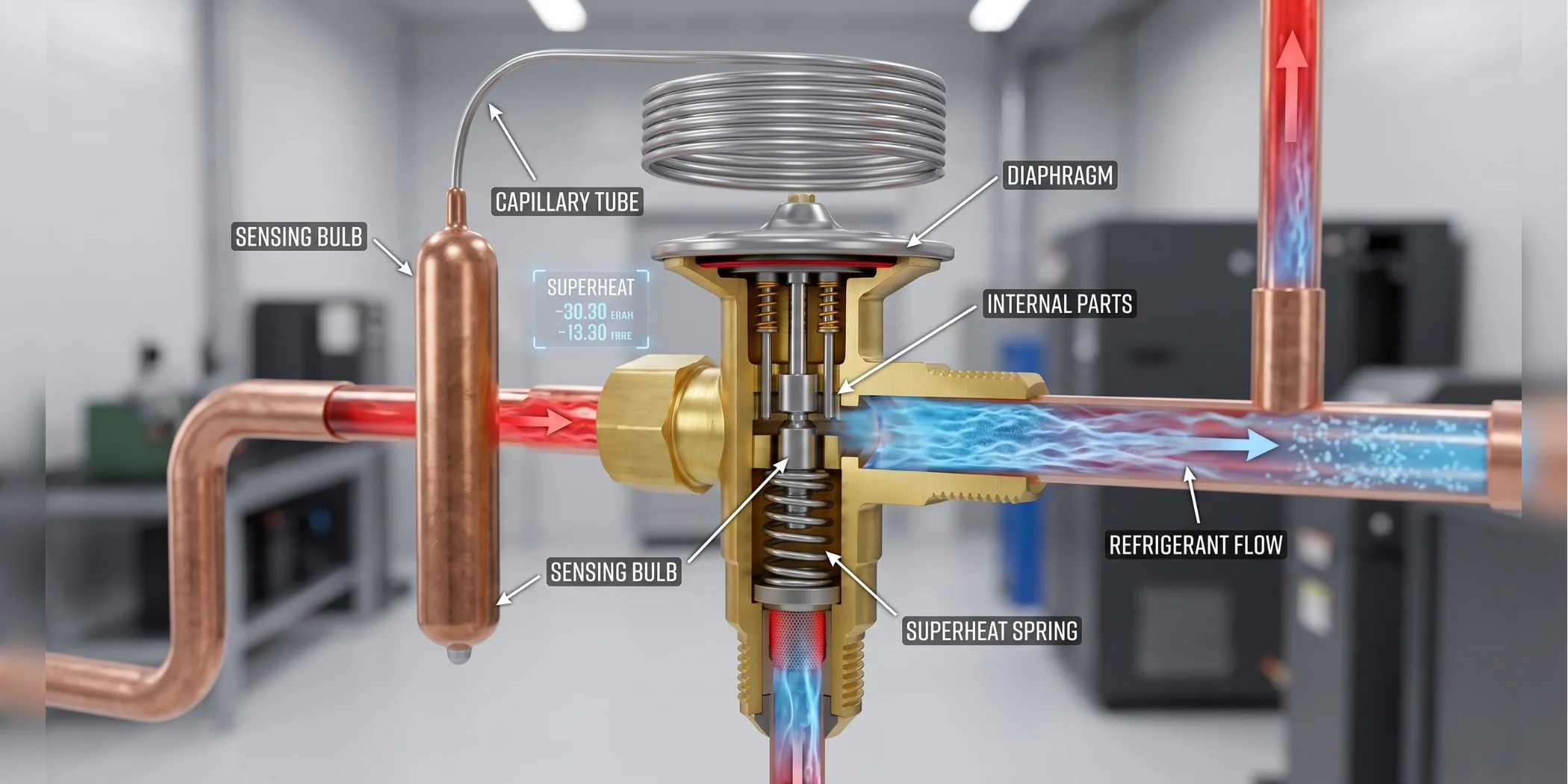
A Thermostatic Expansion Valve (TXV) works by restricting the flow of high-pressure liquid refrigerant, forcing it through a small orifice to drop its pressure and temperature right before it enters the indoor evaporator coil.
Its primary job is to dynamically meter refrigerant flow to keep the evaporator coil operating efficiently while maintaining a precise “superheat” temperature to protect the compressor from liquid damage.
The Two Core Functions
- The Pressure Drop: High-pressure, warm liquid refrigerant from the outdoor condenser reaches the narrow TXV orifice. As it squeezes through, it experiences a dramatic pressure drop. This converts it into a cold, low-pressure mixture of liquid and flash gas, primed to absorb heat from your indoor air.
- Superheat Regulation: The TXV (Thermal Expansion Valve) ensures that all liquid refrigerant boils completely into a gas before leaving the indoor coil. The extra temperature the gas picks up after completely evaporating is called superheat. The valve targets a stable superheat (usually 10°F to 14°F) to prevent unevaporated liquid from slugging and destroying the compressor.
The Three Governing Forces
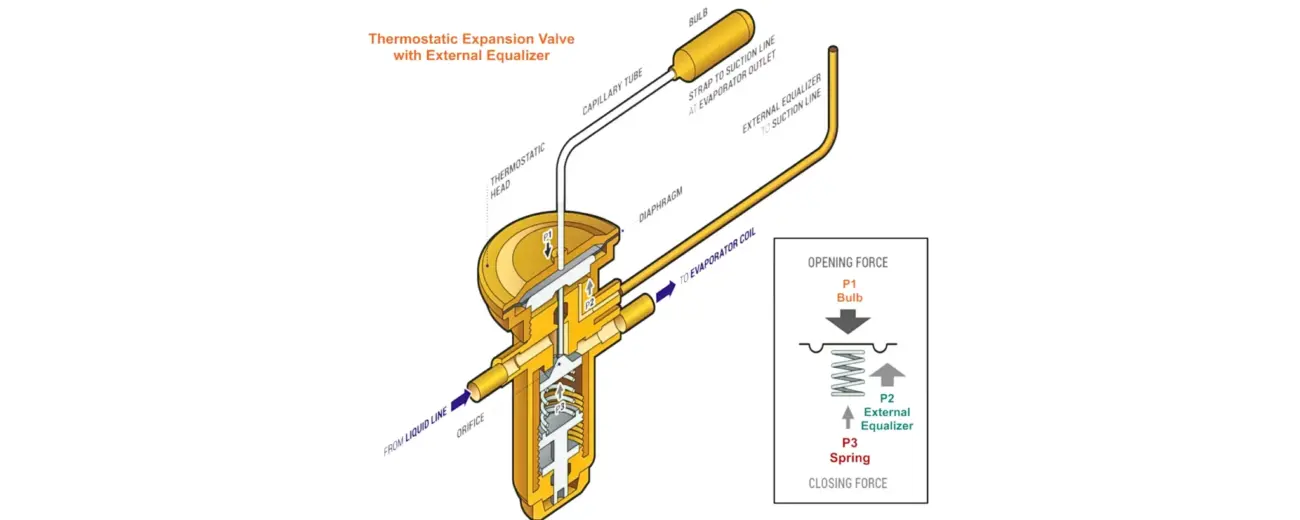
The TXV functions as a mechanical scale, constantly balancing three distinct pressures against an internal flexible diaphragm:
| Force | Component | Direction | Role in System |
| Sensing Bulb Pressure (P₁) | Attached to the evaporator outlet tube. | Downward (Opening force) | Filled with a separate charge. As the AC load spikes and the pipe warms up, the fluid inside expands and pushes down to open the valve. |
| Evaporator Pressure (P₂) | Read via an internal or external equalizer line. | Upward (Closing force) | Tracks the actual pressure inside the cooling coil to resist the bulb force and prevent overfeeding. |
| Spring Pressure (P₃) | A mechanical spring inside the valve body. | Upward (Closing force) | Provides a constant baseline resistance that establishes the system’s factory superheat setting. |
How it Adapts to Changing Indoor Heat
- When your home is hot (High Load): The indoor air warms the evaporator coil aggressively. The refrigerant vaporizes early, causing the outlet line to get hot. The sensing bulb feels this heat, its internal pressure increases (P₁), and it overcomes the closing forces to push the internal pin down. This opens the valve wider, feeding more liquid refrigerant to meet the heavy cooling demand.
- When your home cools down (Low Load): The heat crossing the coil drops, leaving excess cold liquid refrigerant near the outlet. The sensing bulb cools down, lowering its pressure (P₁). The internal spring and equalizer pressures (P₂ + P₃) seize control and push the pin back up. This restricts the flow, preventing raw liquid from spilling out of the coil.