
- Actuators
- Adapters
- Air Blowers
- Air Conditioners
- Air Curtains
- Air Purifiers
- Anemometers
- Axial fans
- Ball Valves
- Belimo
- Blowers
- Brackets
- Brass
- Brazing Rods
- Capacitors
- Carrier Parts
- Clamp Meters
- Cleaning Products
- Coatings
- Compressors
- Condensate Pumps
- Connectors
- Contactors
- Copper Capillary
- Copper Coils
- Copper Straight Tubes
- Copper Strainers
Temperature Increases Resistance

Temperature Increases Resistance
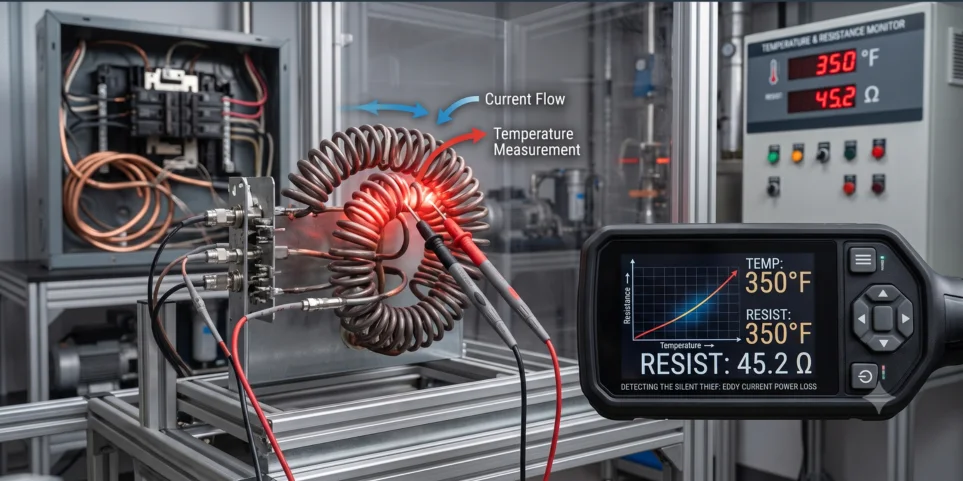
In most common metallic conductors (like copper and aluminum), as temperature goes up, electrical resistance also goes up. This is because the material has a positive temperature coefficient.
- At lower temperatures: Atoms in the wire are relatively still, allowing electrons a clearer, more direct path to flow through.
- At higher temperatures: The metal atoms vibrate aggressively. This increased thermal agitation creates a “chaotic highway,” making it much more difficult for electrons to pass through without colliding.
The Impact on Electrical Machines
In electrical machinery (such as motors, transformers, and compressors), the relationship between heat and resistance creates a critical engineering challenge.
The Thermal Runaway Risk
If an electrical machine operates under a heavy load, it draws more current.
Because heat scales with the square of the current, temperature rises rapidly.
This temperature spike increases the resistance of the copper windings.
If the system cannot dissipate this heat quickly enough, a dangerous cycle begins: higher resistance creates even more heat, leading to potential efficiency drops or total insulation failure.
Key Consequences in Machines:
- Voltage Drop: Increased resistance in supply wires causes a larger voltage drop before the electricity even reaches the machine’s core components, forcing it to work harder.
- Efficiency Loss: Energy that should be converted into mechanical work (like turning a motor shaft) is instead wasted as ambient heat.
- Insulation Degradation: Most electrical motors fail not because the metal melts, but because the intense heat degrades the protective enamel or varnish insulating the copper windings, causing a catastrophic short circuit.
What is the key to protecting machines during extreme heat?
To combat this, electrical machines are designed with specific insulation classes (e.g., Class B, Class F or Class H) rated to handle specific maximum operating temperatures, and utilize cooling mechanisms like internal fans, fins, or liquid coolants to keep resistance—and heat—under tight control.