
- Actuators
- Adapters
- Air Blowers
- Air Conditioners
- Air Curtains
- Air Purifiers
- Anemometers
- Axial fans
- Ball Valves
- Belimo
- Blowers
- Brackets
- Brass
- Brazing Rods
- Capacitors
- Carrier Parts
- Clamp Meters
- Cleaning Products
- Coatings
- Compressors
- Condensate Pumps
- Connectors
- Contactors
- Copper Capillary
- Copper Coils
- Copper Straight Tubes
- Copper Strainers
Are LRA and Inrush Current the Same?

Are LRA and Inrush Current the Same?
No, LRA (Locked Rotor Amps) and inrush current are not exactly the same thing, although they are frequently used interchangeably in everyday HVAC and electrical conversations.
The primary difference lies in how they are measured and what physical phenomenon they represent.
Direct Comparison
| Feature | Inrush Current | Locked Rotor Amps (LRA) |
| What it is | The instantaneous peak surge when power is first applied. | The sustained current is drawn while the motor is physically not spinning. |
| Duration | Extremely brief (first 1 to 3 electrical cycles, or ~20–60 milliseconds). | Slower; lasts from 100 milliseconds up to several seconds until the motor accelerates. |
| Peak Value | Highest overall spike (can be up to 2 to 3 times higher than LRA). | Typically 5 to 7 times higher than normal running current (FLA/RLA). |
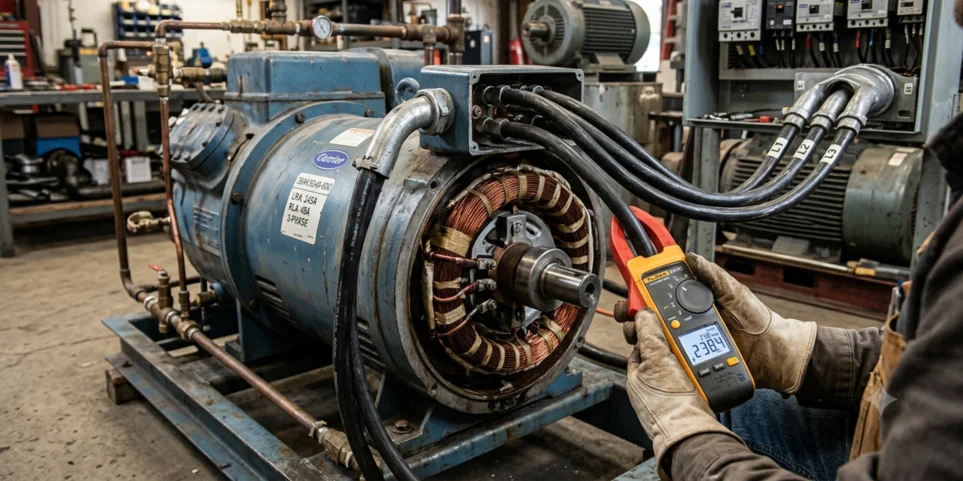
| Measurement | Measured using specialized “Inrush” settings on a digital clamp meter. | A standard RMS rating printed directly on the manufacturer nameplate. |
Understanding the Difference
- Inrush Current (The Magnetic Jolt): The absolute moment you flip the switch, the motor’s copper windings act like a massive sponge absorbing electricity. Because no magnetic field has been established yet, you get a massive, instantaneous spike in power. This “inrush” spike happens so quickly that standard multimeters cannot even catch it without a dedicated “Inrush mode”.
- Locked Rotor Amps (The Mechanical Drag): Once that initial magnetic spike clears (after a few milliseconds), the motor tries to turn. While the motor is fighting to get from a dead stop to full speed, it draws LRA. If you were to mechanically clamp the motor shaft so it couldn’t spin at all, the machine would continuously draw LRA until a circuit breaker tripped or the motor burned out.