
- Actuators
- Adapters
- Air Blowers
- Air Conditioners
- Air Curtains
- Air Purifiers
- Anemometers
- Axial fans
- Ball Valves
- Belimo
- Blowers
- Brackets
- Brass
- Brazing Rods
- Capacitors
- Carrier Parts
- Clamp Meters
- Cleaning Products
- Coatings
- Compressors
- Condensate Pumps
- Connectors
- Contactors
- Copper Capillary
- Copper Coils
- Copper Straight Tubes
- Copper Strainers
Decoding Electrostatic vs. Electromagnetic Fields


Decoding Electrostatic vs. Electromagnetic Fields with
Non-Contact AC Voltage Detectors, Clamp Meters, and Multimeters
Is Electrostatic Field the Same As Electromagnetic Field?
No, an electrostatic field is not the exact same thing as an electromagnetic field, although they are closely related branches of physics.
An electrostatic field is just one component that can become part of an electromagnetic field under the right conditions.
The Key Differences between Electrostatic and Electromagnetic Fields:
- Electrostatic Field (Stationary): This field is created purely by voltage (electric potential) and exists even when charges are perfectly still. For example, a toaster that is plugged into the wall but turned off has an electrostatic field around the cord because voltage is present, but no current is moving. Voltage can be present without current moving because voltage is electrical pressure, while current is the actual flow of electricity.
- Electromagnetic Field (Dynamic): This field is a combination of two forces—an electric field and a magnetic field—working together. It only occurs when electrical charges are moving or accelerating (current is flowing), or when alternating current (AC) is constantly changing direction.
Electrostatic vs Electromagnetic Fields Comparison
| Feature | Electrostatic Field | Electromagnetic Field |
| Primary Source | Voltage alone | Moving charges / Alternating current (AC) |
| Components | Electric field only | Electric and magnetic fields combined |
| Current Flow | No current required | Requires flowing current or changing waves |
| Real-world Example | Static cling on clothes | Wi-Fi signals, X-rays, and radio waves |

Can WIPCOOL AVD24 Non-Contact AC Voltage Detector Detect Electromagnetic Field?
No, the Wipcool AVD24 cannot detect electromagnetic fields (EMFs). It is strictly designed as a non-contact AC voltage detector, meaning electrostatic field.
Why It Only Detects Electric Fields
- Targeted Sensor: The Wipcool AVD24 relies entirely on a capacitive sensor located in its tip. This sensor is engineered exclusively to pick up the electrostatic/electric field generated by live alternating current (AC) voltage.
- Missing Magnetic Component: It does not possess an internal induction coil or a Hall-effect sensor, which are the specialized components required to measure or detect the magnetic fields produced by flowing current.
- Zero Current Testing: Because it ignores magnetic fields entirely, the AVD24 can tell you if a wire is live and dangerous even if the appliance is turned off and no current is moving at all.
What You Need for EMF Detection
If your goal is to locate or measure electromagnetic radiation, you would need to use a dedicated EMF Meter / Gauss meter. Those devices are designed specifically to analyze magnetic radiation from power lines, transformers, and electronic appliances.
Can a Clamp Meter or Multimeter Detect Electromagnetic Fields?
A clamp meter can inherently detect the magnetic component of an electromagnetic field (EMF), while a standard multimeter cannot detect EMF on its own.
Neither tool acts exactly like a dedicated EMF safety reader, but their individual capabilities differ significantly due to how they are built:
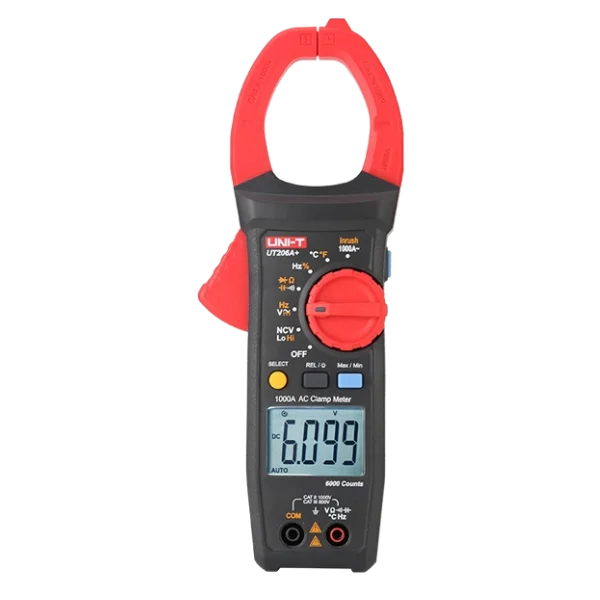
1. Clamp Meters (Can Detect Magnetic Fields)
A clamp meter’s primary function is measuring current (amperage), and it does this explicitly by sensing the magnetic field radiating from a wire.
- How it works: When you clamp the jaws around a single active wire, the internal iron core detects the strength of the magnetic field and displays it as current.
- The EMF Catch: Clamp meters are engineered to cancel out fields when clamped around a standard power cord containing both hot and neutral wires. Because the currents flow in opposite directions, their magnetic fields cancel each other out, resulting in a reading of zero. To use it like an EMF sensor, you have to split the wires and clamp only one
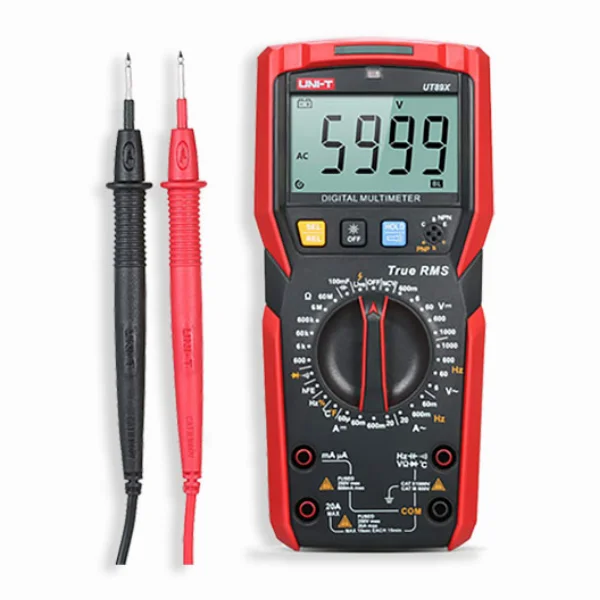
2. Standard Multimeters (Cannot Detect Fields Directly)
A standard multimeter cannot measure fields over the air because it requires direct, metal-to-metal contact to read voltage or current.
- The Limitation: It has no internal antennae or magnetic coils to pick up ambient fields radiating from a device.
- The Advanced Exception: For diagnostic purposes, you can technically connect a specialized external EMF probe accessory to a multimeter’s input jacks to read magnetic fields or radio frequencies on the screen.
Dedicated EMF Meters vs. Electrical Tools
If you are assessing environmental radiation or tracking interference, a specialized EMF meter is still required. A clamp meter only tells you how much magnetic force is tightly bound around an active electrical conductor. It cannot tell you how many milligauss (mG) of ambient radiation are polluting a room or leaking from a microwave.
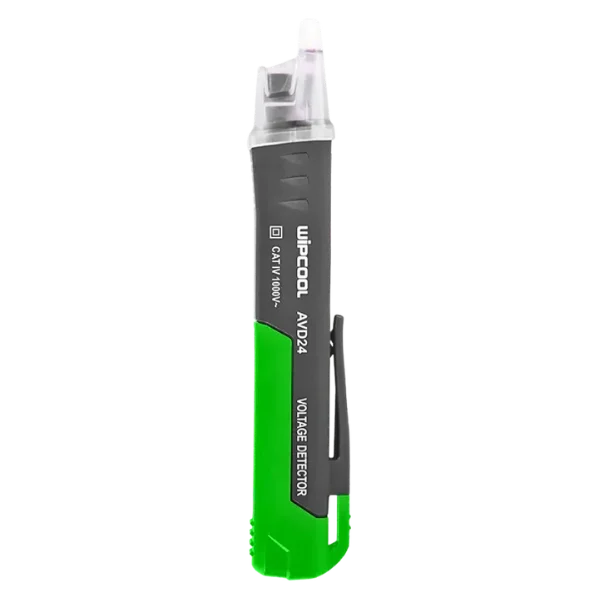
A Side-by-Side Comparison: Non-Contact AC Voltage Detectors, Clamp Meters, and Multimeters:
| Feature | Non-Contact AC Voltage Detector (e.g., Wipcool AVD24) |
Clamp Meter | Multimeter |
| Primary Purpose | Quick safety checks / presence of power | Measuring high AC current (Amperage) | Measuring exact Voltage, Resistance, and Continuity |
| Physical Contact Needed? | No (senses fields through insulation) | No for current; Yes for voltage testing | Yes (requires direct metal-to-metal probe contact) |
| What It Detects/Measures | Electrostatic / Electric fields only | Magnetic fields (current) & Voltage via probes | Direct electrical signals via test leads |
| Provides Numerical Values? | No (uses LED lights and buzzer alarms) | Yes (displays precise digital readings) | Yes (displays precise digital readings) |
| Can Trace Hidden Cable Breaks? | Yes (can follow a wire to find where power stops) | No | No |
| Main Safety Benefit | Keeps hands completely away from exposed wires | Allows high current testing without breaking the circuit | Safe for low-voltage, but requires handling live contacts |