

- Actuators
- Adapters
- Air Blowers
- Air Conditioners
- Air Curtains
- Air Purifiers
- Anemometers
- Axial fans
- Ball Valves
- Belimo
- Blowers
- Brackets
- Brass
- Brazing Rods
- Capacitors
- Carrier Parts
- Clamp Meters
- Cleaning Products
- Coatings
- Compressors
- Condensate Pumps
- Connectors
- Contactors
- Copper Capillary
- Copper Coils
- Copper Straight Tubes
- Copper Strainers
Why Deburring of Copper Pipes Matters


Why Deburring of Copper Pipes Matters
Here’s a Hint : The Copper Pipes Are Singing!
(And it’s music to no one’s ears)
When you cut a copper pipe, it leaves an inward-facing metal lip (a burr). You must use a deburring tool to remove it because:
1. Deburring Prevents “Erosion-Corrosion” (Pinholes)
- The Problem: High-velocity refrigerant often contains droplets of liquid oil and liquid refrigerant.
- The Burr Effect: When this mixture hits a sharp burr, it creates an intense, ultra-high-velocity localized vortex directly after the restriction.
- The Damage: This vortex repeatedly blasts liquid droplets into the copper wall at the exact same spot. Over a few months or years, it literally erodes the copper from the inside out, causing a microscopic pinhole leak.
2. Deburring Stops System Noise
- A burr acts like a reed in a whistle. This point is discussed in more detail below.
- Normal turbulent flow is a low, rushing sound. A burr transforms that into a high-pitched, annoying humming, whistling, or buzzing that can vibrate through walls and bother homeowners.
3. Deburring Prevents Pressure Drops & Capacity Loss
- An inward-facing burr reduces the inner diameter of the pipe.
- This acts like a tiny, unintended expansion valve. It restricts the volume of refrigerant returning to the compressor, forcing the compressor to work harder, consume more electricity, and drop the cooling efficiency of the AC.
4. Deburring Avoids Compressor Failure
- When a technician pushes a copper pipe into a fitting (like a coupling or a flare joint), a sharp burr can shave off microscopic copper flakes.
- These metal shavings travel through the system and will eventually destroy the compressor valves or clog the critical metering device (TXV or capillary tube).
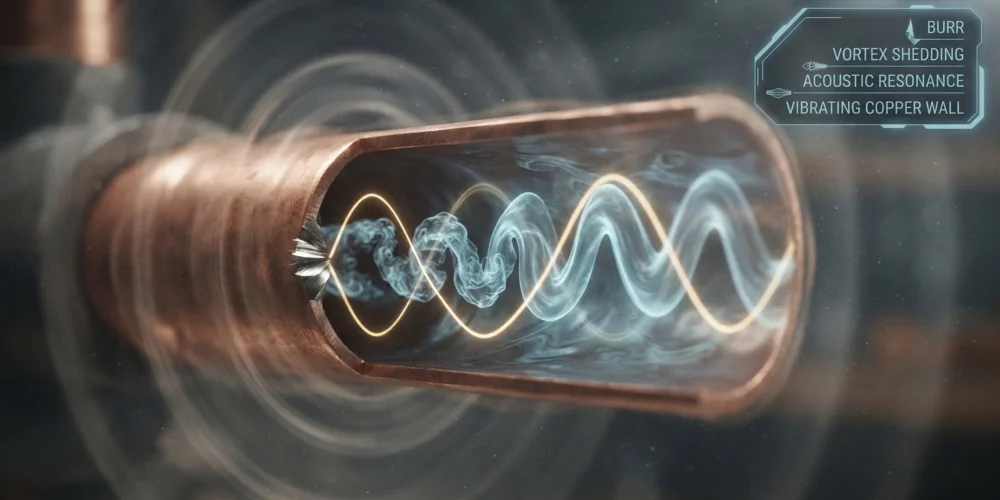
How a Burr Generates Noise From The Copper Pipe
- The Whistle Effect: The burr acts exactly like the reed in a musical instrument or the edge of a whistle.
- Vortex Shedding: As high-velocity refrigerant forces its way past the sharp restriction, it creates a rapid chain of turbulent eddies directly behind the burr. This phenomenon is called vortex shedding.
- Acoustic Resonance: If the frequency of these shedding eddies matches the natural resonant frequency of the copper pipe, the metal will vibrate. You will hear this vibration from the outside as a distinct humming, buzzing, or whistling noise.
The natural resonant frequency is the specific pitch or rate of vibration at which an object naturally wants to vibrate when it is disturbed.
Every physical object—a guitar string, a wine glass, or a copper pipe—has one.
The natural resonant frequency is discussed in more detail later in this article.
Is Deburring Needed Even Though The Internal Flow Of Refrigerant Inside The Copper Pipe Is Turbulent?
Yes, deburring is absolutely mandatory for HVAC lines, even though the internal flow is already turbulent.
While the normal flow is turbulent, it is a controlled, predictable turbulence designed for heat transfer. A burr introduces a completely different, destructive type of chaos.

How to Visualize the Flow Inside the Pipe (turbulence ahead!)
- The Restriction Obstacle: Think of the un-deburred metal lip as a tiny ring-shaped wall blocking the outer edge of the pipe.
- The Flow Separation: As the liquid and gaseous refrigerant rushes forward, it cannot turn sharp corners. It slams into the burr and is forced inward toward the center of the tube.
- The Micro-Eddies (Wake Region): Directly behind the sharp edge of the burr, a low-pressure dead zone is created. Because the main fluid stream is moving so fast, it drags the fluid in this dead zone along with it, forcing it to spin backward. This forms tiny, chaotic swirling loops known as micro-eddies or recirculation zones.
- Vortex Shedding: These eddies don’t stay in one place. They constantly build up pressure, detach from the burr, and sweep downstream in a chaotic chain. This continuous “shedding” breaks down any smooth laminar flow and creates the high-frequency acoustic pressure waves that you hear outside the pipe as a hum or whistle.
Laminar flow is a type of fluid motion where the fluid travels smoothly in regular, parallel paths or layers.
In air conditioning systems, refrigerant is highly pressurized and pumped at high speeds by the compressor to maximize heat transfer. Because of this high velocity and the constant phase changes (liquid turning to gas), the flow inside an HVAC pipe is almost always turbulent rather than laminar.

HVAC Horror: The Singing Copper Tubing
The copper pipe has a natural resonant frequency determined by its length and thickness.
Thinner copper pipes will generally resonate more easily and vibrate more intensely than thicker copper pipes. Thinner copper tubes have less physical mass. It takes very little kinetic energy from refrigerant flow or a tiny internal burr to start shaking a lightweight piece of copper. Thicker tubes are heavier and require a much stronger internal force to get moving
When refrigerant flows past an internal burr, it creates a rapid chain of swirling fluid loops or mini-eddies called vortex shedding. When the rhythmic pulsing of these eddies matches the unique natural vibration rate of the copper pipe, it triggers acoustic resonance. The two forces lock together, causing the entire pipe to vibrate intensely like a stereo speaker. It triggers acoustic resonance—instantly amplifying the sound into a loud hum.
Think of natural resonant frequency as a property or a sleeping trait, and acoustic resonance as the action or the event that wakes it up.
Here is the exact difference:
1. Natural Resonant Frequency (The Potential)
- What it is: A physical characteristic of an object. It is the specific pitch at which an object wants to vibrate if disturbed.
- Status: It always exists, even when the object is completely silent and still.
- Example: A guitar string has a natural resonant frequency based on its thickness and tension. Even when the guitar is sitting untouched in its case, that frequency exists as a latent property of the string.
2. Acoustic Resonance (The Event)
- What it is: The physical phenomenon that happens when an external sound wave or vibration hits an object at its exact natural resonant frequency, causing it to vibrate intensely.
- Status: It is an active process that requires an energy source.
- Example: If you sing the exact right note (sound wave) near that guitar, the string will suddenly start vibrating all by itself without anyone touching it. That physical reaction is acoustic resonance.
Acoustic resonance creates noise precisely because it vibrates the air. Sound cannot travel without a medium, and the air acts as that medium.
Here is the exact step-by-step physics of how acoustic resonance transforms an invisible internal fluid restriction into a loud, audible hum outside the pipe:
1. The Copper Pipe Becomes a Speaker Cone
When resonance occurs, the copper pipe itself begins to flex and shake violently at its natural frequency. At this moment, the hard metal surface of the pipe acts exactly like the cone of a stereo speaker.
2. Compression and Rarefaction (Vibrating the Air)
As the pipe walls rapidly vibrate back and forth (hundreds of times per second), they slam into the surrounding air molecules:
- Compression: When the pipe wall flexes outward, it shoves the air molecules together, creating a high-pressure pocket.
- Rarefaction: When the pipe wall instantly snaps back inward, it leaves an empty space behind, creating a low-pressure pocket.
3. The Sound Wave Travels
This rapid, alternating chain of high-pressure and low-pressure pockets ripples outward through the room like a wave in a pond. This ripple is the sound wave.
4. Your Eardrum Vibrates
When this vibrating wave of air molecules reaches your ear, it physically pushes and pulls on your eardrum at that exact same frequency. Your brain interprets those rapid air-pressure changes as a continuous humming, buzzing, or whistling noise.
The Amplification Factor
Without resonance, a tiny internal burr only makes a microscopic splash in the refrigerant. But when resonance occurs, the entire length of the copper pipe joins in on the vibration. Because a long pipe moves a massive volume of air compared to a tiny burr, the sound is amplified significantly—making it loud enough to hear through walls.