
- Actuators
- Adapters
- Air Blowers
- Air Conditioners
- Air Curtains
- Air Purifiers
- Anemometers
- Axial fans
- Ball Valves
- Belimo
- Blowers
- Brackets
- Brass
- Brazing Rods
- Capacitors
- Carrier Parts
- Clamp Meters
- Cleaning Products
- Coatings
- Compressors
- Condensate Pumps
- Connectors
- Contactors
- Copper Capillary
- Copper Coils
- Copper Straight Tubes
- Copper Strainers
Delay On Make Timer Relay vs Delay On Break Timer Relay

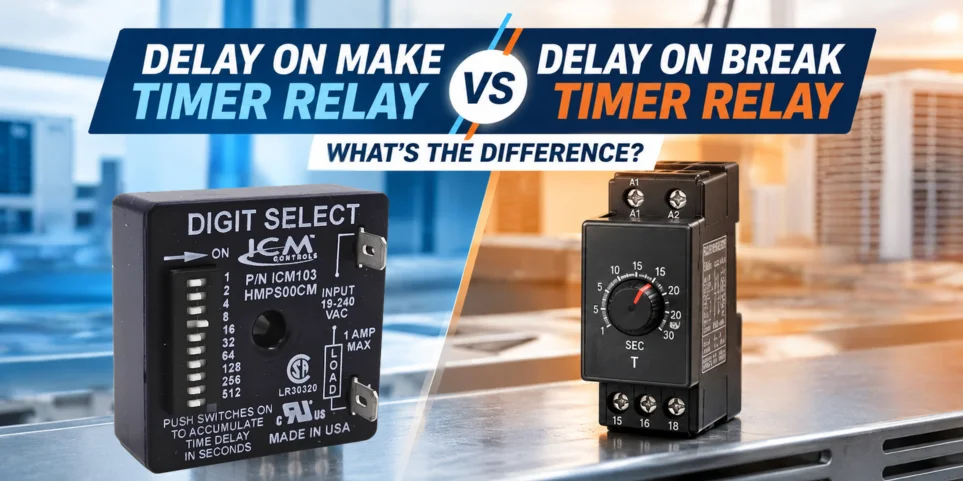
Delay On Make Timer Relay vs Delay On Break Timer Relay
What are the differences?
The main difference between a delay-on-make and a delay-on-break timer relay is when the timing sequence starts relative to receiving an input signal.
Direct Comparison
| Feature | Delay-on-Make (ON-Delay) | Delay-on-Break (OFF-Delay) |
|---|---|---|
| When Timing Starts | As soon as power is applied (input signal received). | As soon as power is removed (input signal broken). |
| State During Countdown | The load stays OFF. | The load stays ON. |
| Action After Countdown | Contacts close (makes the circuit); equipment turns ON. | Contacts open (breaks the circuit); equipment turns OFF. |
| Primary Purpose | Prevents rapid short-cycling or staggers startup loads. | Keeps a device running for a set time after shutoff. |
| HVAC Example | Keeps the A/C compressor off for 5 minutes after a power flicker. | Keeps the blower fan running to clear residual hot/cold air. |
How They Work (Step-by-Step)
⏱️ Delay-on-Make (ON-Delay)
- The thermostat calls for cooling/heating (power is applied to the timer).
- The timer starts counting down (e.g., 3 minutes). The load remains OFF.
- Once the time expires, the relay closes (“makes” the contact) and the equipment turns ON.
- The equipment runs normally until the thermostat is satisfied.
🛑 Delay-on-Break (OFF-Delay)
- The system is running normally.
- The thermostat finishes its cycle and stops calling for cooling/heating (power signal is removed/broken).
- Instead of shutting off instantly, the timer triggers and starts counting down.
- The load stays ON during this countdown.
- Once the time expires, the relay opens (“breaks” the contact) and the equipment finally turns OFF.
Common HVAC Applications
- Use Delay-on-Make if: You want to protect expensive components like air conditioning compressors from short-cycling (turning on and off too quickly, which can destroy the motor) or if you want to stagger the startup of multiple units so they don’t trip a main circuit breaker.
- Use Delay-on-Break if: You want to optimize energy efficiency by running an indoor blower fan for an extra 60 to 90 seconds after the heating or cooling elements turn off. This pushes the remaining conditioned air out of the ductwork and into the living space.