
- Actuators
- Adapters
- Air Blowers
- Air Conditioners
- Air Curtains
- Air Purifiers
- Anemometers
- Axial fans
- Ball Valves
- Belimo
- Blowers
- Brackets
- Brass
- Brazing Rods
- Capacitors
- Carrier Parts
- Clamp Meters
- Cleaning Products
- Coatings
- Compressors
- Condensate Pumps
- Connectors
- Contactors
- Copper Capillary
- Copper Coils
- Copper Straight Tubes
- Copper Strainers
Differences Between Kriwan INT69 and INT369 Protection Modules

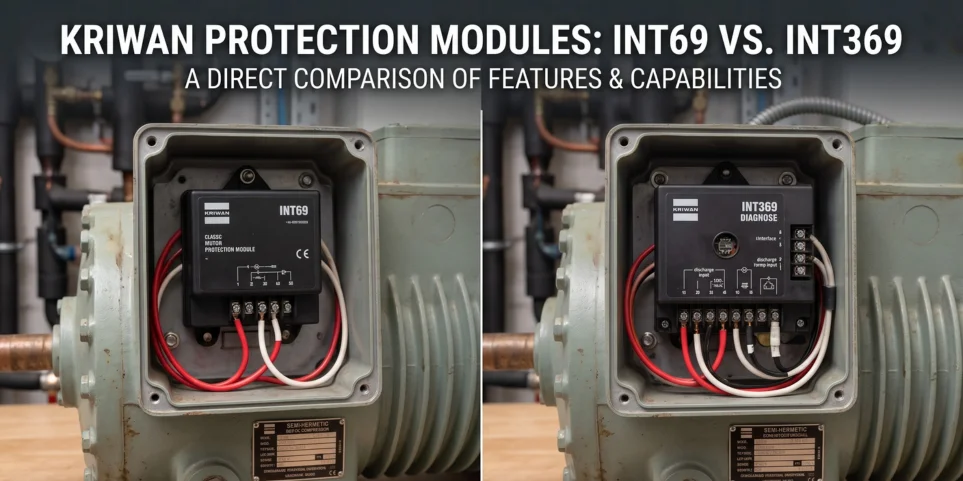
Differences Between Kriwan INT69 and INT369 Protection Modules
While both the Kriwan INT69 and Kriwan INT369 are solid-state motor protection modules designed to read PTC thermistor sensors inside compressor windings, they differ significantly in their sensor processing, tracking intelligence, and how they handle voltage faults.
The fundamental difference is that the INT69 is a streamlined, single-circuit sensor relay, whereas the INT369 is an advanced, independent-input protection system designed for split-winding monitoring and low-voltage protection.
Key Technical Differences
| KRIWAN INT69 |
| 1 Sensor Loop Input (Up to 9 PTCs chained) |
| ● Static Protection |
| KRIWAN INT369 |
| 3 Independent Inputs (Individual PTC pairs) |
| ● Static Protection |
| ● Dynamic Protection |
| ● Low Voltage Trip |
1. Sensor Connection Method (Series vs. Individual)
- INT69: Evaluates PTC thermistors wired together in a single series circuit loop. Up to 9 individual PTC sensors can be daisy-chained together into one measurement channel. If any single sensor hits its trip resistance, the entire loop opens.
- INT369: Features individual, dedicated terminal inputs. It is primarily engineered for large compressor motors where the PTC sensors are led out independently (such as dual-winding or part-winding start motors). It evaluates each input stream on its own.
2. Evaluation Logic (Static vs. Dynamic)
- INT69: Features Static Protection. It trips the control circuit instantly only when the maximum temperature threshold is physically reached (when sensor resistance hits ≈ 4.5 kΩ).
INT369: Features Dual Static & Dynamic Protection.In addition to a standard high-temperature trip, INT369 calculates the rate of temperature change.
If a locked rotor or phase loss causes winding temperatures to skyrocket unusually fast, the INT369 Diagnose trips the system before the motor ever reaches critical heat limits.
3. Low-Voltage / Brownout Monitoring
- INT69: Focuses purely on thermal constraints and ancillary inputs like oil sensors. It does not natively handle main power grid drops.
- INT369: Natively incorporates Low-Voltage protection. It actively measures its incoming module supply voltage and instantly shuts off the compressor if voltage drops below a fixed threshold (e.g., 16.5V on a 24V system), protecting the contactors and winding insulation from brownout damage.
4. Footprint and Diagnostics
- INT69: Features a highly compact box format explicitly designed to slide easily into small, congested compressor electrical junction terminal boxes.
- INT369: Standardized into a slightly larger physical housing block to accommodate multiple independent terminal connections.
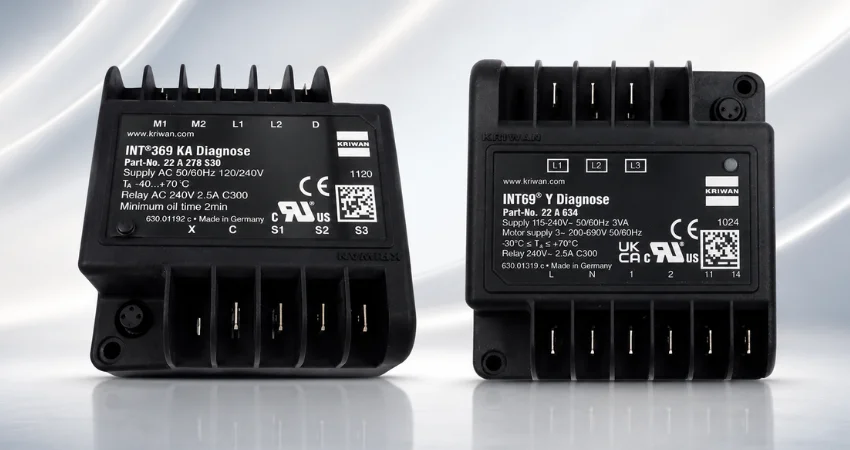
Comparison Matrix
| Kriwan INT69 | Kriwan INT369 |
| Sensor Logic Single-circuit loop evaluation (series). | Sensor Logic Multi-circuit independent evaluation. |
| Max PTC Sensors Up to 9 sensors chained together. | Max PTC Sensors Typically 3 dedicated input sets. |
| Thermal Monitoring Static (Trips strictly at high heat point). | Thermal Monitoring Static & Dynamic (Trips early on rapid temp spike). |
| Voltage Protection None. | Voltage Protection Built-in low-voltage / brownout lockout. |
| Typical Compressor Size Small to Medium commercial units. | Typical Compressor Size Heavy industrial / multi-winding motors. |
Did you know?
We have an extensive range of Kriwan INT69 and INT369 protection modules in our range. You can read more about them here https://wearehvac.com/kriwan-motor-protectors/