

- Actuators
- Adapters
- Air Blowers
- Air Conditioners
- Air Curtains
- Air Purifiers
- Anemometers
- Axial fans
- Ball Valves
- Belimo
- Blowers
- Brackets
- Brass
- Brazing Rods
- Capacitors
- Carrier Parts
- Clamp Meters
- Cleaning Products
- Coatings
- Compressors
- Condensate Pumps
- Connectors
- Contactors
- Copper Capillary
- Copper Coils
- Copper Straight Tubes
- Copper Strainers
Low Delta T? Belimo Can Help With That!


How Can Belimo Help With Low Delta T Syndrome?
In a chilled water piping system, Delta T (Δ T) is the temperature difference between the water entering and leaving the chiller’s heat exchanger. Delta T is the primary metric used to measure building heat load, determine chiller capacity, and monitor system efficiency. It measures how much heat the building’s air conditioning system has stripped from the air and transferred into the water loop.
Because modern commercial facilities utilize water loops for both absorbing heat from the building and rejecting it outside, there are actually two distinct water loop Delta T measurements to track.
1. Chilled Water Delta T (Evaporator Loop)
This measures the heat being absorbed from the building’s air conditioning coils. It is calculated at the chiller’s evaporator barrel:
- Supply Temperature: Cold water leaving the chiller to cool the building, typically around 5.5°C to 6.7°C (42°F to 44°F ) .
- Return Temperature: Warmer water coming back after absorbing building heat, typically around 12.2°C to 13.8°C (54°F to 57°F ).
- Standard Split Between Evaporator Supply & Return Temperatures: Traditionally designed for a 5.5°C (10°F) difference. However, energy codes like ASHRAE Standard 90.1 push modern high-efficiency designs toward a 8.3°C (15°F ) target to reduce pumping energy.
2. Condenser Water Delta T (Condenser Loop)
On water-cooled chillers, this loop measures the heat being removed from the chiller into the outdoor cooling tower:
- Standard Values: Typically enters the condenser from the tower at 29.4°C (85°F) and returns to the tower at 35°C (95°F).
- Standard Split Between Condenser Supply & Return Temperatures: Designed for a 5.5°C (10°F) difference under full load.
Why Delta T Matters in Water Pipes
Low Delta T Syndrome – Belimo Can Help With This!
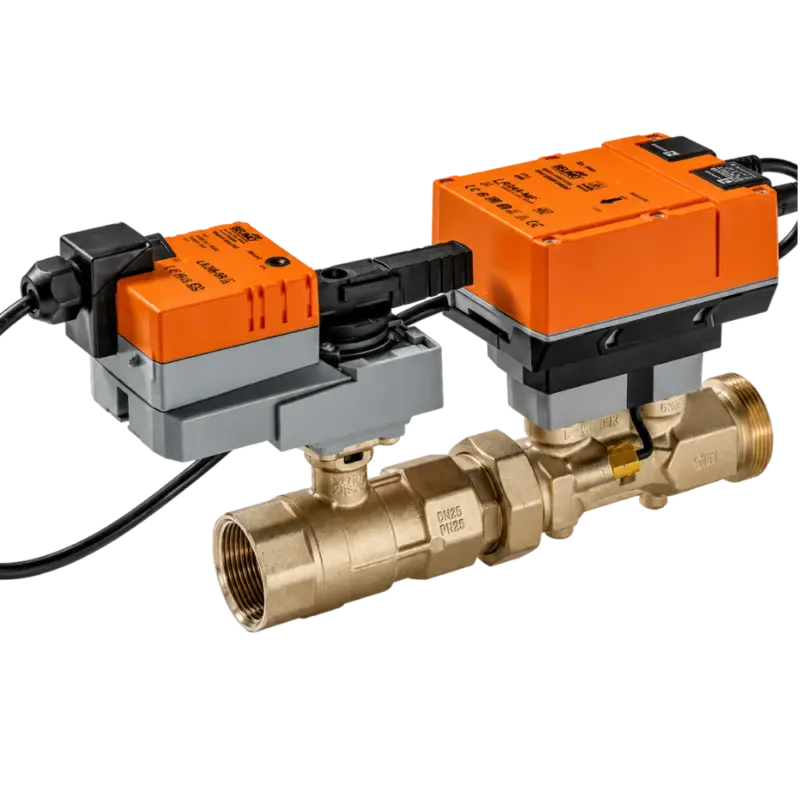
A major inefficiency in central plants occurs when the return water temperature stays too low. Known as Low Delta T Syndrome, this occurs when water moves through the building without successfully transferring its heat energy. Common triggers include:
- Dirty or fouled air handler coils
- Oversized bypass or control valves
- Incorrect system hydronic balancing
This syndrome forces the plant to run extra, unnecessary pumps and chillers just to satisfy water volume demands, driving up electricity costs significantly.
Belimo Switzerland is world-famous in the HVAC industry specifically because they invented the hardware that solves Low Delta T Syndrome at the individual equipment level.
While central plants suffer from Low Delta T, Belimo’s philosophy is that you cannot fix Delta T at the chiller itself. Instead, their products target the root cause: individual air handling units (AHUs) and heat exchangers overflowing with water they cannot extract heat from.
Their primary product line addressing this is the Belimo Energy Valve™
The Core Product: Belimo Energy Valve™
The Belimo Energy Valve is an all-in-one smart device that combines a characterized control valve, an ultrasonic flow meter, two temperature sensors (for supply and return lines), and a microprocessor-driven actuator.
Belimo Energy Valves mitigate Low Delta T Syndrome by combining multi-sensor hardware with automated flow-restriction logic directly at the building’s air handlers.
The primary cause of Low Delta T is “overflow”. This happens when a cooling coil reaches its heat transfer limit (saturation point), but a conventional valve keeps opening, forcing excess water through the coil without absorbing any extra heat.
The Belimo Energy Valve stops this process using a four-step framework:
1. Integrated Hardware Architecture
Instead of using separate components, a single Belimo unit functions as an all-in-one smart assembly containing:
- An ultrasonic or electromagnetic flow meter to track real-time GPM.
- Two immersion temperature sensors clamped to the supply and return piping.
- A pressure-independent control valve that maintains precise water volume regardless of system pressure fluctuations.
- An intelligent microprocessor actuator to run algorithmic logic locally.
2. The Delta T Manager Algorithm
The valve features a patented, built-in Delta T Manager. Technicians program the design Delta T of the specific air handling coil (such as 15°F) into the valve software.
- The Trigger: The temperature sensors continuously calculate the actual temperature split. If the real-time Delta T falls below the user-defined design setpoint for more than a few minutes, the valve identifies that the coil is overflowing water.
- The Correction: The valve automatically overrides the building automation system’s call for more water and begins to modulate closed, reducing the volumetric flow rate (GPM).
3. Eliminating the Power Saturation Point
As the valve restricts the water flow, the velocity of the remaining water slows down inside the coil tubes. This gives the water more time to absorb heat from the air stream.
- The cooling power output of the coil remains identical, but the Delta T rises back up to the design setpoint.
- By cutting out the useless “overflow water,” the valve completely cures Low Delta T at the local level before that cold water can return to the central chiller plant.
4. Ongoing Analytics & Transparency
Every valve possesses BACnet or Modbus communication capabilities. This allows it to feed data back to the cloud or building management software to support continuous commissioning. Facility teams can visually graph coil degradation, log BTUs, map load trends, and catch stuck or leaking bypass valves across branches.
Real-World Impact on Chiller Plants
By installing Belimo Energy Valves at terminal units throughout a building loop, the impact cascades directly back to the central chiller room:
- Pumping Cost Reductions: Eliminating overflow across dozens of coils can drop required system flow rates significantly—sometimes up to 40% lower flow for the exact same thermal building comfort. This saves massive amounts of electricity on variable-frequency drive (VFD) water pumps.
- Optimized Chiller Staging: When return water returns at its true design temperature (e.g., 55°F instead of a degraded 48°F), chillers can run at their maximum rated capacity. This stops the plant manager from having to turn on a second or third multi-million dollar chiller just because the water volume demand is high