- Actuators
- Adapters
- Air Blowers
- Air Conditioners
- Air Curtains
- Air Purifiers
- Anemometers
- Axial fans
- Ball Valves
- Belimo
- Blowers
- Brackets
- Brass
- Brazing Rods
- Capacitors
- Carrier Parts
- Clamp Meters
- Cleaning Products
- Coatings
- Compressors
- Condensate Pumps
- Connectors
- Contactors
- Copper Capillary
- Copper Coils
- Copper Straight Tubes
- Copper Strainers
A2L and A3 Refrigerants

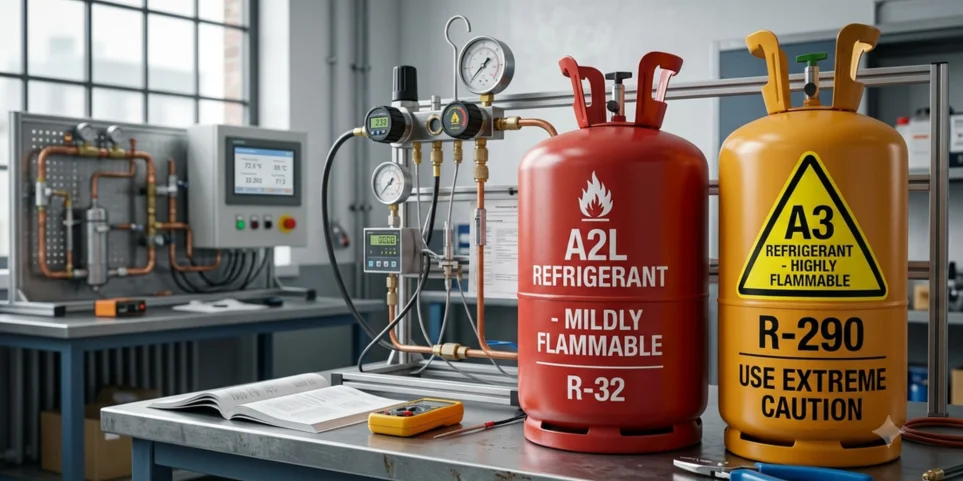
What are A2L Refrigerants
A2L refrigerants are “mildly flammable” synthetic gases consisting of hydrofluorocarbons (HFCs), hydrofluoroolefins (HFOs), or a blend of both.
- The “2L” Designation: Represents lower flammability (2) combined with a slow burning velocity (L) of less than 10 centimeters per second.
- Ignition Difficulty: They require a high concentration in the air to catch fire and need roughly 1,000 times more ignition energy than A3 gases. They are highly unlikely to ignite from static electricity or a dropped cigarette.
- Usage: They serve as the primary replacement for older, non-flammable A1 refrigerants like R-410A in residential air conditioners and commercial chillers.
- Common Examples: R-32, R-454B, and R-1234yf.
What are A3 Refrigerants?
A3 refrigerants are “highly flammable” natural hydrocarbon gases.
- The “3” Designation: Represents high flammability with a low lower flammability limit (LFL) and rapid burning velocities.
- Ignition Risk: They ignite exceptionally easily with very low energy sources, including small static electricity shocks.
- Usage: Because they pose a higher explosion hazard, safety standards strictly limit their volume capacity. They are primarily limited to small, factory-sealed, self-contained systems like domestic refrigerators, commercial vending machines, and small portable AC units.
- Common Examples: R-290 (propane) and R-600a (isobutane).
Direct Technical Comparison
| Characteristics | A2L Refrigerants | A3 Refrigerants |
| Flammability Level | Mildly flammable | Highly flammable |
| Burning Velocity | Slow (<10 cm/s) | Fast (>10 cm/s, e.g., propane is ~46 cm/s) |
| Ignition Energy Required | Very high (Hard to ignite) | Very low (Ignites easily) |
| Leak Concentration Risk | Requires a major leak to ignite | Small leaks easily reach an explosive mix |
| Allowable System Volume | Large volumes permitted | Strictly restricted to small amounts |
| Typical Tools Needed | Spark-proof certified tools | Explosion-proof heavy-duty equipment |
Did you know?
We have WIPCOOL vacuum pumps and recovery units specially engineered for A2L refrigerants.
We also have INFICON handheld leak detectors certified for both A2L and A3 refrigerants.