

- Actuators
- Adapters
- Air Blowers
- Air Conditioners
- Air Curtains
- Air Purifiers
- Anemometers
- Axial fans
- Ball Valves
- Belimo
- Blowers
- Brackets
- Brass
- Brazing Rods
- Capacitors
- Carrier Parts
- Clamp Meters
- Cleaning Products
- Coatings
- Compressors
- Condensate Pumps
- Connectors
- Contactors
- Copper Capillary
- Copper Coils
- Copper Straight Tubes
- Copper Strainers
Contactors With Auxiliary or Auxiliary Contactors

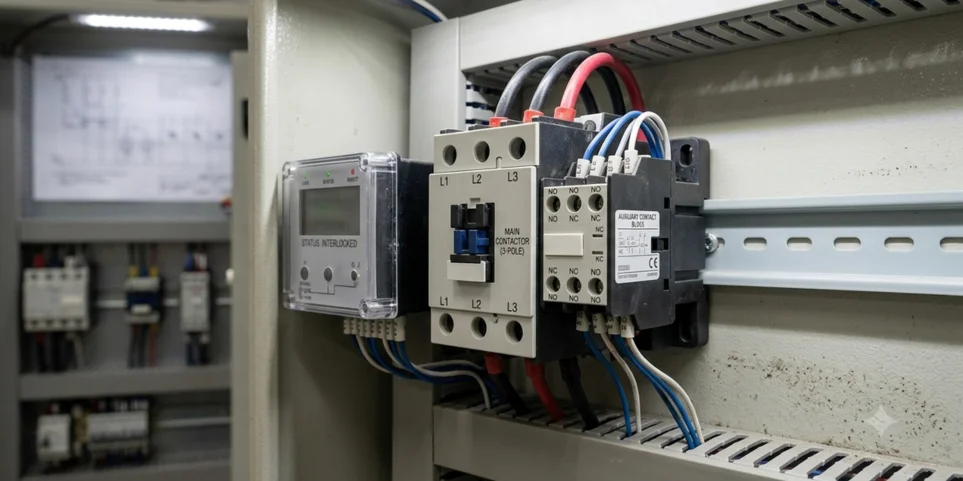
Contactors With Auxiliary or Auxiliary Contactors
In an air conditioning system, an auxiliary contactor (more commonly referred to as auxiliary contacts attached to a main contactor) acts as a secondary switch that operates in tandem with the main power switch.
While the main contactor handles the heavy lifting—switching the high-current power directly to the compressor and condenser fan—the auxiliary contacts handle low-current control and interlocking signals.
Here is exactly what they do for an AC system:
1. Electrical Interlocking (Safety & Logic)
Auxiliary contacts are frequently used to ensure that two conflicting components cannot run at the same time, or that one must run before another can start.
- Example: It can be wired to ensure the outdoor compressor cannot turn on unless the indoor blower fan is already running. If the blower fails, the auxiliary contact prevents the compressor from turning on and freezing up the coils.
2. Status Monitoring and Feedback
Modern or commercial AC units often report their status to a smart thermostat, a Building Management System (BMS), or a control board.
- Because the auxiliary contacts open and close at the exact same time as the main high-voltage contacts, they send a safe, low-voltage (usually 24V or dry contact) signal to the control board saying, “Yes, the contactor has physically closed and the compressor should be running.”
3. Controlling Secondary Components
Sometimes, starting the compressor requires other low-power accessories to turn on simultaneously. Auxiliary contacts can safely control:
- Crankcase Heaters: Turning the heater off when the compressor runs, and turning it back on when it stops.
- Solenoid Valves: Opening refrigerant liquid line solenoids right as the system kicks on.
- Indicator Lights: Powering a green “System Running” light or a red “Fault” light on a control panel.
NO vs. NC Auxiliary Contacts
Auxiliary contacts come in two structural types depending on what the AC system needs them to do:
| Type | State when Contactor is OFF | State when Contactor is ON | Common AC Use Case |
| Normally Open (NO) | Open (De-energized) | Closed (Energized) | Sending a “compressor running” status signal to a control board or turning on an indicator light. |
| Normally Closed (NC) | Closed (Energized) | Open (De-energized) | Turning off a crankcase heater when the compressor starts, or interlocking to prevent a backup system from turning on. |
Differences between Auxiliary Contactors and Contactors WITHOUT Auxiliary
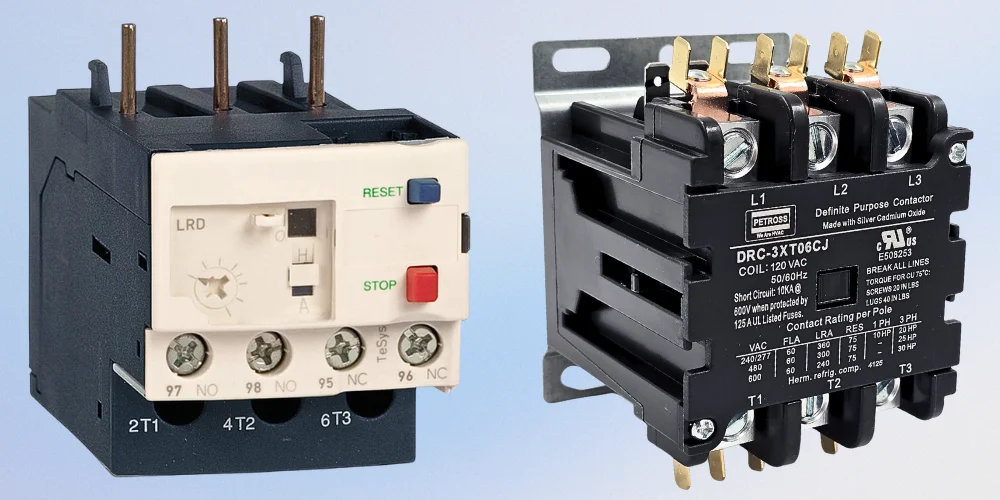
In air conditioning (AC) systems, the primary difference is that contactors with auxiliary contacts provide low-voltage status feedback or control interlocking to the HVAC system, while contactors without auxiliary contacts only turn the main compressor or fan on and off.
HVAC Quick Comparison
| Feature | AC Contactor WITH Auxiliary | AC Contactor WITHOUT Auxiliary |
| System Feedback | Sends a “compressor running” signal to control boards or a BMS. | No feedback; the system assumes it is running. |
| Component Interlocking | Prevents secondary parts (like a heater) from starting unless the fan runs. | Cannot physically interlock with other components. |
| Application Type | Commercial chillers, multi-stage systems, smart HVAC. | Standard residential split units and window ACs. |
| Wiring Complexity | Higher; includes low-voltage signal wiring. | Low; only basic coil and high-power load wires. |
| Cost & Footprint | Slightly more expensive and larger footprint. | Highly economical, compact, and widely available. |
Air Conditioners WITH Auxiliary Contacts
These are standard high-power contactors equipped with secondary, low-current terminals (Normally Open or Normally Closed). They are vital in advanced or automated HVAC setups for three main reasons:
- Building Management System (BMS) Integration: The auxiliary contact closes alongside the main power contacts, sending a low-voltage (24V or 12V) “Run Status” signal back to a central One Elec control system or automation panel.
- Safety Interlocking: It ensures safe operational sequences. For example, the auxiliary circuit can prevent an electric duct heater from turning on unless the contactor for the indoor blower fan has successfully closed first.
- Crankcase Heater Control: It can handle complementary sub-systems. A Normally Closed (NC) auxiliary contact can be wired to keep a compressor crankcase heater on while the AC is idle, but safely cut power to it the exact moment the main compressor starts up.
Air Conditioners Using No Auxiliary Contacts
These are traditional, straightforward “definite purpose” contactors used in the vast majority of standard residential outdoor condensing units.
- Pure Power Delivery: Their only job is to snap shut when the 24V thermostat calls for cooling, sending high-voltage power straight to the compressor and condenser fan motor.
- Blind Operation: The main control board relies on time delays rather than hardwired feedback. It assumes the compressor is running simply because it sends voltage to the contactor coil.
- Easy Replacement: They are the industry standard for basic HVAC servicing. Technicians favor them for simple installations due to their clear terminal layouts and low cost.