- Actuators
- Adapters
- Air Blowers
- Air Conditioners
- Air Curtains
- Air Purifiers
- Anemometers
- Axial fans
- Ball Valves
- Belimo
- Blowers
- Brackets
- Brass
- Brazing Rods
- Capacitors
- Carrier Parts
- Clamp Meters
- Cleaning Products
- Coatings
- Compressors
- Condensate Pumps
- Connectors
- Contactors
- Copper Capillary
- Copper Coils
- Copper Straight Tubes
- Copper Strainers
What are the different IP or Ingress Protection Ratings?

What are the different IP or Ingress Protection Ratings?
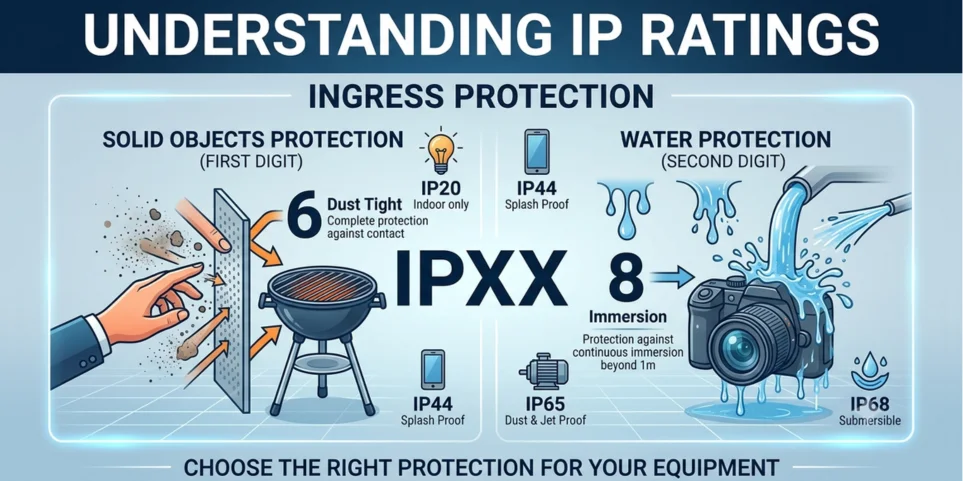
IP (Ingress Protection) ratings classify the degrees of protection provided by an electrical enclosure against the intrusion of solid objects and liquids. Defined by the International Electrotechnical Commission (IEC 60529), a standard rating consists of the letters “IP” followed by two numbers (e.g., IP67).
The Structure of an IP Rating
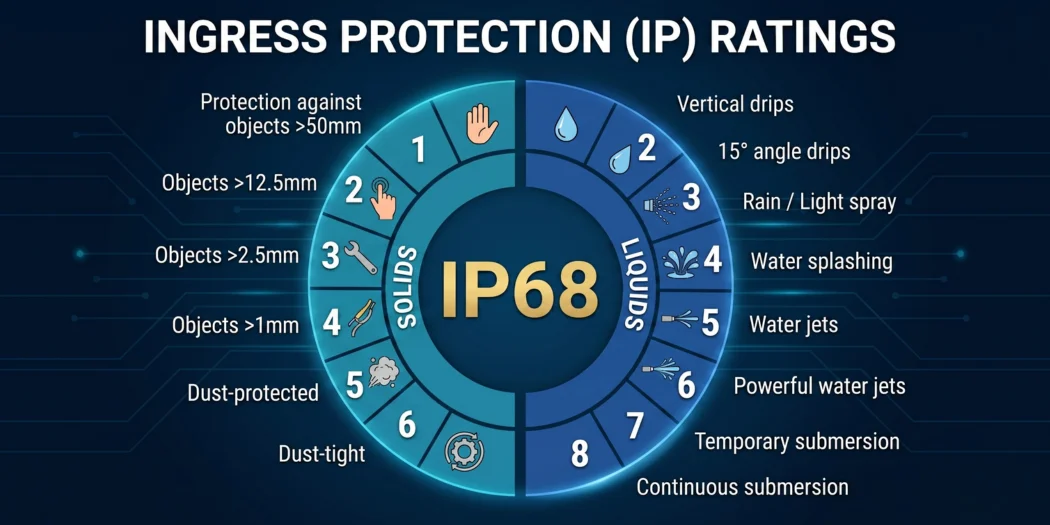
- First Digit (0–6): Measures protection against solid particles like dust, tools, and fingers.
- Second Digit (0–9): Measures protection against liquids like splashes, rain, and submersion.
- The Letter “X”: Indicates that the device has not been tested for that specific category (e.g., IPX7 means it has no official dust rating).
First Digit: Solid Particle Protection
This digit scales from large objects down to microscopic dust particles.
| DIGIT | protection level | Test Details / Application |
|---|---|---|
| 0 | No protection | No barrier against any contact. |
| 1 | Objects > 50 mm | Large body surfaces like the back of a hand. |
| 2 | Objects > 12.5 mm | Fingers or similar small physical objects. |
| 3 | Objects > 2.5 mm | Tools, thick wires, and screwdrivers. |
| 4 | Objects > 1 mm | Most wires, slender screws, and large insects. |
| 5 | Dust-protected | Limited dust entry; does not interfere with operation. |
| 6 | Dust-tight | Complete protection; no dust can enter. |
Second Digit: Liquid Protection
This digit scales from light vertical condensation up to high-pressure submersion.
Note: Ratings 7, 8, and 9K focus on immersion and high pressure, but do not automatically guarantee compliance with lower-level water jet tests (like 5 or 6) unless explicitly dual-certified.
| DIGIT | protection level | Test Details / Application |
|---|---|---|
| 0 | No protection | Zero resistance to moisture. |
| 1 | Vertically dripping water | Protects against light, falling rain drops. |
| 2 | Dripping water at 15° tilt | Protects against water drops when tilted. |
| 3 | Spraying water | Resistant to water spraying up to a 60° angle. |
| 4 | Splashing water | Protected against splashes from any direction. |
| 5 | Low-pressure water jets | Can withstand water projected from a nozzle. |
| 6 | High-pressure water jets | Protected against powerful jets or heavy seas. |
| 7 | Temporary immersion | Survives submersion up to 1 meter for 30 minutes. |
| 8 | Continuous immersion | Survives deep, long submersion (depth set by manufacturer). |
| 9K | High-pressure/temp jets | Withstands close-range, high-temperature washdowns. |
Common Real-World Ratings
- IP20: Common for indoor home electronics; safe from fingers but not water.
- IP54: Found on general outdoor fixtures; resists typical dust and light rain.
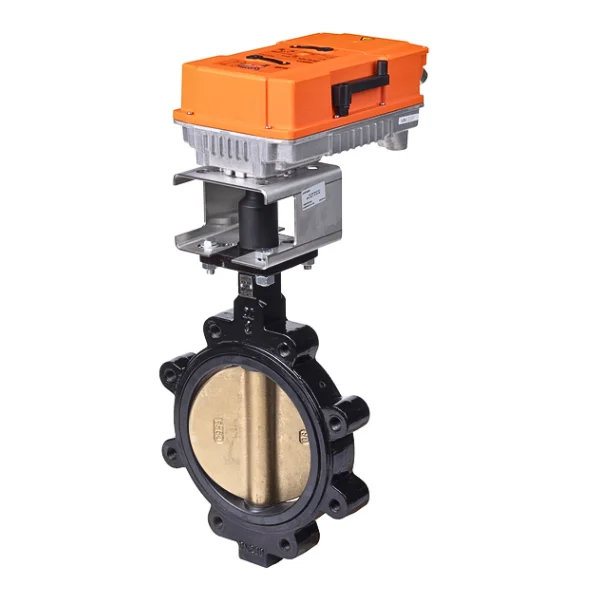
- IP65 / IP66: Standard for heavy-duty outdoor lighting and security cameras. We have Belimo actuators with IP66 rating
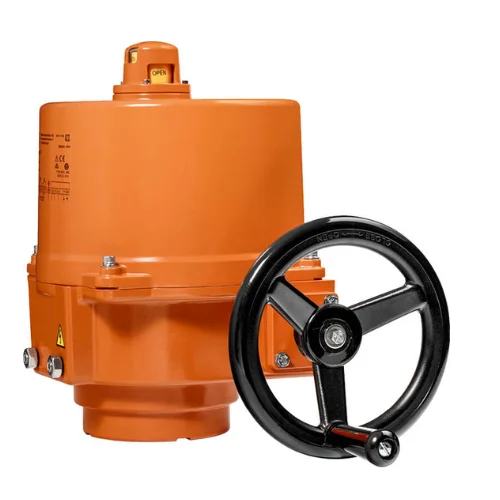
IP67 / IP68: Found on modern smartphones and smartwatches to survive accidental drops into pools or sinks. We have Belimo actuators with IP67 rating.
Did You Know?
NEMA and IP are two different rating systems. They test for different hazards. They are used in different parts of the world.
Key Differences
- NEMA is North American. It is set by the National Electrical Manufacturers Association.
- IP is international. It is set by the International Electrotechnical Commission (IEC).
- NEMA tests for extra hazards. It includes corrosion, oil, and ice.
- IP only tests for two things. It only rates dust and water.
The Conversion Rule
- You can convert NEMA to IP.
- You cannot convert IP to NEMA.
NEMA ratings define the environmental protection levels for electrical enclosures used in North America. Established by the National Electrical Manufacturers Association, these standards help you choose the right enclosure to protect electrical components from dust, water, and corrosion.
Standard NEMA Ratings Overview
The table below breaks down the most common NEMA ratings, their locations, and what they protect against.
| NEMA Rating | Environment | Key Protections | Typical Applications |
| NEMA 1 | Indoor | Light dust, accidental touch | Commercial offices, control rooms |
| NEMA 3R | Outdoor | Rain, sleet, snow, external ice | Outdoor power boxes, utility meters |
| NEMA 4 | Indoor/Outdoor | Windblown dust, rain, hose-directed water | Car washes, industrial factories |
| NEMA 4X | Indoor/Outdoor | Windblown dust, hose water, corrosion | Swimming Pools, marine environments, chemical plants |
| NEMA 12 | Indoor | Circulating dust, lint, fibers, oil/coolant seepage | Automated manufacturing floors |
| NEMA 13 | Indoor | Dust, spraying water, oil and non-corrosive coolants | Machine tool workshops |
Non-Hazardous vs. Hazardous Locations
NEMA ratings are broadly divided into two environments:
Non-Hazardous (Standard) Environments
These focus on weatherproofing, dustproofing, and water ingress.
- NEMA 1 through 6 and 11 through 13 handle general industrial, commercial, and outdoor environments.
- The higher the number, generally the more intense the liquid protection (e.g., NEMA 4 handles high-pressure hoses, while NEMA 6 can handle temporary submersion).
Hazardous Locations (Explosion-Proof)
These are specialized enclosures designed for environments containing volatile gases, vapors, or combustible dust.
- NEMA 7: Designed for indoor explosive gas environments (Class I, Division 1).
- NEMA 9: Designed for indoor explosive dust environments (Class II, Division 1).
Key Rating Comparison Details
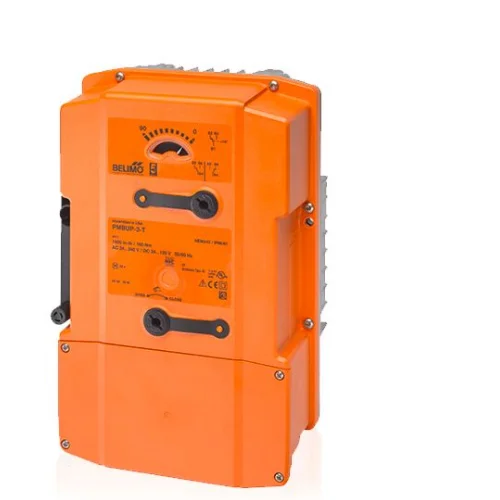
- NEMA 4 vs. NEMA 4X: Both offer the exact same dust and high-pressure water protection. However, NEMA 4X adds mandatory corrosion resistance, usually requiring stainless steel or fiberglass. Here is a picture of a Belimo actuator offering NEMA 4X
- NEMA 3R vs. NEMA 4: NEMA 3R only protects against falling rain, sleet, or snow. NEMA 4 adds complete protection against airborne dust and directly sprayed hose water.
- NEMA 12 vs. NEMA 13: Both protect against indoor dust and dripping water, but NEMA 13 features specialized oil-resistant gaskets to keep out industrial lubricants and cutting coolants.
Did You Also Know?
We have Hidria axial fans with high IP ratings and Belimo actuators with both high IP and NEMA ratings. We have it covered!