- Actuators
- Adapters
- Air Blowers
- Air Conditioners
- Air Curtains
- Air Purifiers
- Anemometers
- Axial fans
- Ball Valves
- Belimo
- Blowers
- Brackets
- Brass
- Brazing Rods
- Capacitors
- Carrier Parts
- Clamp Meters
- Cleaning Products
- Coatings
- Compressors
- Condensate Pumps
- Connectors
- Contactors
- Copper Capillary
- Copper Coils
- Copper Straight Tubes
- Copper Strainers
Joule Heating

Joule Heating
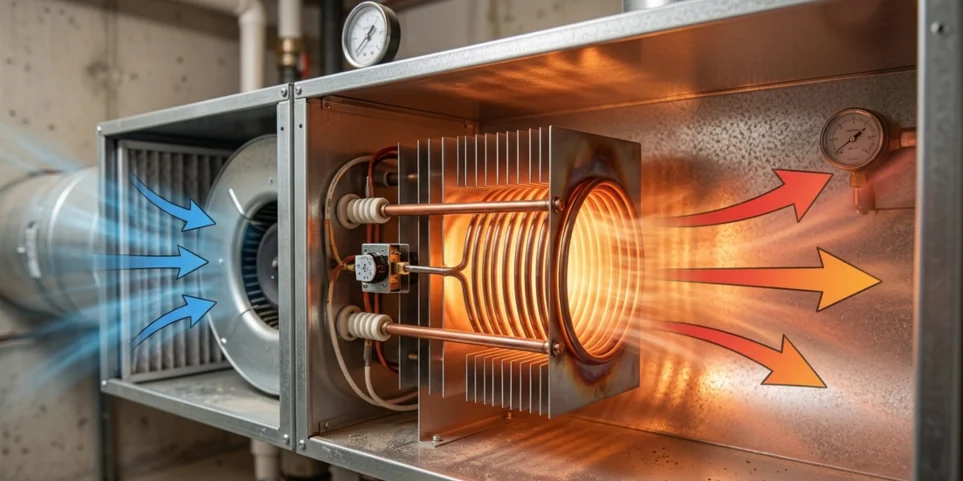
Joule Heating (also known as resistance, ohmic, or resistive heating) is the physical process by which the passage of an electric current through a conductor releases heat.
Simply put: it is the transformation of electrical energy into thermal energy.
The Science: Why Does It Happen?
At the microscopic level, electric current is the flow of free electrons moving through a material. However, a conductor is not empty space; it consists of a solid crystalline lattice of atoms.
- The Collisions: As electrons are pushed through the material by a voltage, they continuously collide with the atoms of the conductor.
- Energy Transfer: Every time an electron crashes into an atom, it transfers some of its kinetic energy to that atom.
- The Result: This transferred energy causes the atoms to vibrate violently. In physics, the collective vibration of atoms in a material is what we perceive macroscopically as heat.
Real-World Applications
Engineers intentionally exploit Joule heating to make everyday appliances work:
- HVAC/R & Space Heaters: Electric duct heaters, crankcase heaters in compressors, and portable space heaters use high-resistance wires (like Nichrome) to deliberately convert electricity into massive amounts of air-warming heat.
- Household Appliances: Toasters, hair dryers, clothing irons, and electric stoves all rely entirely on Joule heating to function.
- Incandescent Light Bulbs: Current is forced through a tiny tungsten filament. The Joule heating is so intense that the wire glows white-hot, producing light.
In electric motors, Joule heating (I2 R losses) is the primary driver of thermal stress. Because a motor converts electrical energy into mechanical energy, any energy turned into heat via Joule heating is not only lost efficiency—it actively degrades the motor’s internal components.
Here is exactly how Joule heating cuts down a motor’s lifespan and where the damage occurs.
1. Accelerated Insulation Breakdown (The #1 Killer)
The copper windings inside a motor are coated with a thin layer of protective insulation (enamel or varnish) to prevent the coils from short-circuiting against each other or the motor frame.
- The 10°C Rule (Arrhenius Rate Law): As a rule of thumb in electrical engineering, for every 10°C increase in operating temperature above a motor’s design limit, the lifespan of its winding insulation is cut in half.
- The Mechanism: Prolonged Joule heating bakes this insulation, making it brittle, cracked, and flaky. Eventually, the insulation fails, causing a turn-to-turn short circuit that permanently destroys the motor.
2. Bearing Degradation and Lubricant Failure
While Joule heating originates in the copper windings, that heat rapidly conducts through the motor shaft and housing to the mechanical bearings.
- Lubricant Thinning: High temperatures lower the viscosity of the grease inside the bearings, causing it to thin out or bleed away. Without proper lubrication, friction increases, creating more heat.
- Mechanical Seizure: Once the grease degrades or dries up completely, metal-on-metal contact causes the bearings to wear out prematurely, leading to increased vibration, physical damage to the rotor, or a completely seized motor.
3. Demagnetization of Permanent Magnets
If you are dealing with Permanent Magnet Motors (like those found in modern high-efficiency HVAC ECMs or electric vehicles), Joule heating poses a direct threat to the magnets.
- The Curie Temperature: Permanent magnets lose their magnetic strength as they get hotter. If Joule heating pushes the internal temperature past a specific threshold (the magnet’s maximum operating temperature), the magnets can suffer irreversible demagnetization.
- The Death Spiral: When a magnet loses strength, the motor must draw more current (I) to produce the exact same amount of torque. Because heat scales with the square of the current (I2 R), this triggers a rapid, destructive thermal spiral.
Summary of Winding Insulation Lifespan by Class
Motor manufacturers use standard insulation classes to dictate how much heat a motor can tolerate before its lifespan plummets:
| Insulation Class | Max Allowable Temperature | Lifespan Impact |
| Class B | 130°C | Standard baseline; degrades rapidly if pushed past limits. |
| Class F | 155°C | Common in heavy-duty industrial and HVAC/R motors; offers a safer thermal margin. |
| Class H | 180°C | High-performance/extreme environment; handles intense Joule heating much longer. |
To maximize a motor’s lifespan, systems must utilize proper overload protection, ensure adequate airflow/cooling, and avoid frequent under-voltage conditions (which force the motor to draw higher current, spiking the I2 R heat).