
- Actuators
- Adapters
- Air Blowers
- Air Conditioners
- Air Curtains
- Air Purifiers
- Anemometers
- Axial fans
- Ball Valves
- Belimo
- Blowers
- Brackets
- Brass
- Brazing Rods
- Capacitors
- Carrier Parts
- Clamp Meters
- Cleaning Products
- Coatings
- Compressors
- Condensate Pumps
- Connectors
- Contactors
- Copper Capillary
- Copper Coils
- Copper Straight Tubes
- Copper Strainers
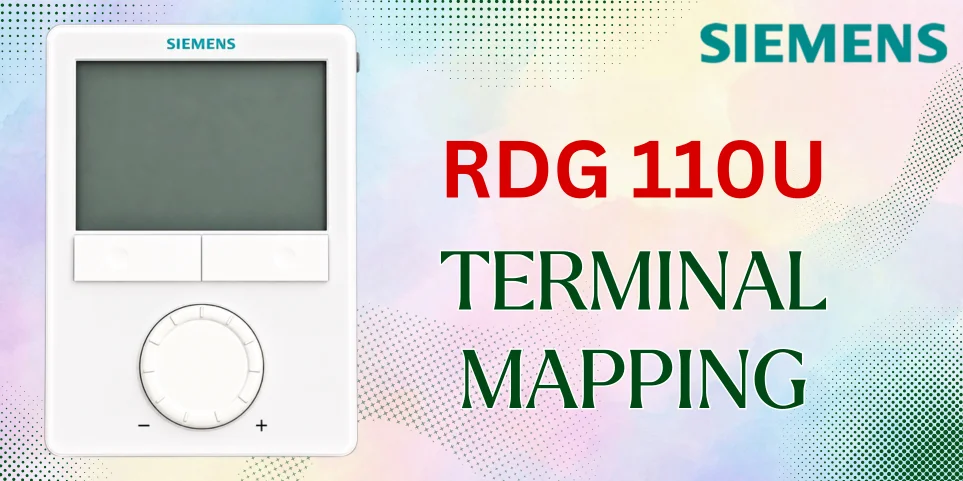
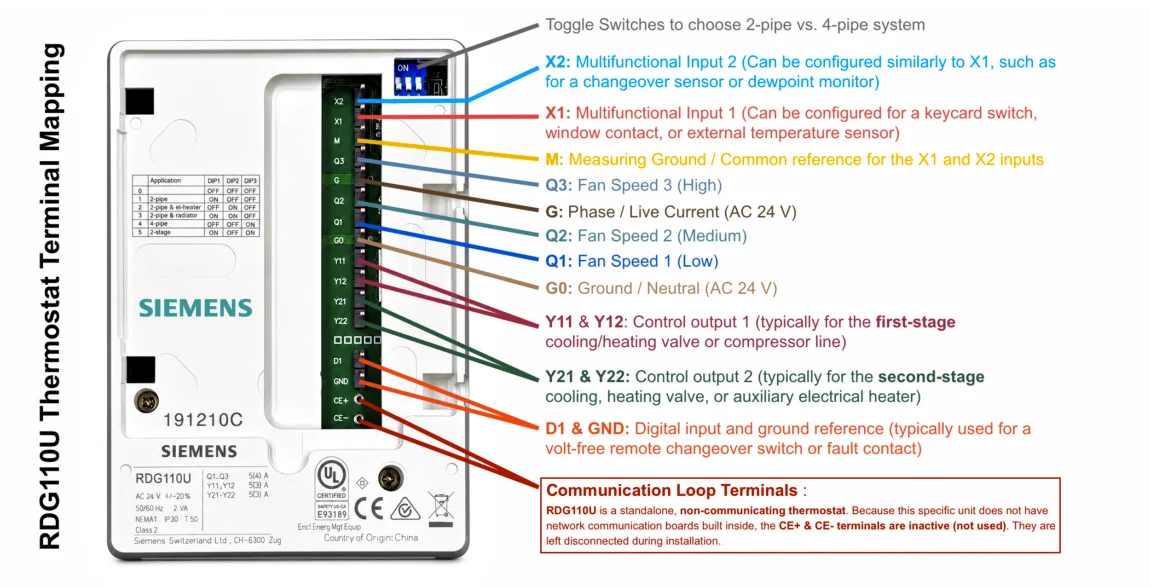
Siemens RDG110U Terminal Mapping

What is a Volt-Free Changeover Switch?
A volt-free remote changeover switch (often called a dry contact or potential-free contact) is a simple relay or switch mechanism that does not supply or carry any voltage of its own.
Instead of sending electrical power to a system, it acts purely as a simple ON/OFF signal (or contact closure) to trigger a function remotely.
How It Works on an HVAC Thermostat (like the Siemens RDG110U)
On terminals like D1 & GND:
- Heating / Cooling Mode Changeover: A central plant or seasonal switch closes the contact across D1–GND to flip the room unit from Cooling mode to Heating mode automatically (e.g., when the building switches from summer to winter operation).
- Occupancy / Economy Mode: A window contact, door card slot (in hotels), or remote timer closes the contact to force the thermostat into Setback / Eco Mode when the room is unoccupied.
- Emergency / Shutdown: A central fire alarm or condensate overflow switch opens/closes the contact to forcibly shut down the fan coil unit.
Why Use Volt-Free Signal Logic?
- Safety & Isolation: Electrically isolates the thermostat’s internal circuits from the connected building automation system, preventing ground loops, electrical noise, or voltage spikes.
- Universal Compatibility: Allows two completely different systems running on different control voltages to safely communicate without risking short circuits or blown control boards.
What is a condensate overflow switch?
A condensate overflow switch (often called a float switch or overflow safety switch) is an emergency safety device installed in an air conditioning or fan coil system to prevent water damage caused by clogged drain lines.
How It Works
- Normal Operation: As an AC unit cools, it creates condensation on the evaporator coil. This water drips into a primary drain pan and flows away out of the building via a PVC drain line.
- The Problem: Over time, algae, dirt, dust, and debris can clog that drain pipe. When this happens, water backs up inside the drain pan.
- The Switch Triggers: The overflow switch is installed directly in the secondary/overflow drain port or inside the pan. It contains a small buoyant float mechanism. When the water level rises to a dangerous level, the float rises with it.
- Safety Shutdown: Rising past a preset threshold trips an internal switch mechanism (often opening or closing a volt-free / dry contact circuit). This immediately cuts power to the thermostat, cooling circuit, or compressor, stopping the AC from producing any more water before the pan overflows into your ceiling or walls.
Common Types of Overflow Switches
- Inline Pipe Switches: Installed directly on the secondary condensate drain pipe outlet. If the main drain backs up, water flows into the secondary line and trips the switch.
- Pan-Mounted Switches: Clamped directly onto the side of the secondary drip pan. They trip as soon as water begins pooling in the secondary pan.
- Electronic / Probe Switches: Use sensors to detect water presence electrically rather than relying on a moving mechanical float.
How It Connects to a Thermostat (like the Siemens RDG)
Depending on your system’s setup, the overflow switch can be wired in two main ways:
- Direct Power Cut: Wired directly in series with the low-voltage control wire (usually the 24V Hot / “R” or “G” wire) so that when tripped, it drops power to the unit completely.
- Signal Input: Wired to a digital input (such as D1 & GND on an advanced thermostat or BMS) so the thermostat receives an alarm signal, displays an error code on the screen, and safely shuts off the cooling output while keeping diagnostic capabilities alive.