- Actuators
- Adapters
- Air Blowers
- Air Conditioners
- Air Curtains
- Air Purifiers
- Anemometers
- Axial fans
- Ball Valves
- Belimo
- Blowers
- Brackets
- Brass
- Brazing Rods
- Capacitors
- Carrier Parts
- Clamp Meters
- Cleaning Products
- Coatings
- Compressors
- Condensate Pumps
- Connectors
- Contactors
- Copper Capillary
- Copper Coils
- Copper Straight Tubes
- Copper Strainers
Supercool or Subcooling in Air Conditioning

Supercool or Subcooling in Air Conditioning
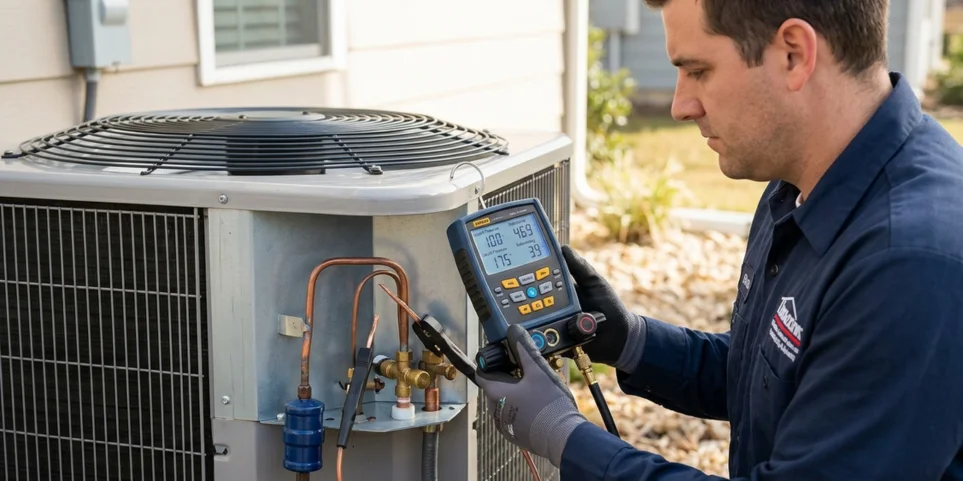
In air conditioning, subcooling (often referred to as “supercool”) is the number of degrees a liquid refrigerant is cooled below its saturation temperature (condensing point). It measures the sensible heat removed from the refrigerant after it has fully changed from a 100% vapor into a 100% liquid state inside the outdoor condenser coil.
The Formula
To calculate subcooling, HVAC technicians measure both the pressure and temperature simultaneously on the liquid line:
Subcooling = Saturation Temperature (Condensing Point) – Actual Liquid Line Temperature
- Saturation Temperature: Found by reading the high-side pressure on a gauge manifold and converting it to temperature using a pressure-temperature (P-T) chart.
- Actual Temperature: Measured using a physical temperature clamp on the copper liquid line (the smaller, warm line) leaving the outdoor unit.
Why Subcooling Matters
Monitoring subcooling is critical for ensuring the system meters refrigerant properly and runs efficiently:
- Solid Liquid Column: A metering device (like a TXV or capillary tube) requires a solid stream of 100% liquid refrigerant to function correctly. Subcooling ensures no vapor bubbles are mixed in, which would otherwise “starve” the indoor evaporator coil.
- Charging Metric: For air conditioners that use a Thermostatic Expansion Valve (TXV), subcooling is the primary method used to determine if the system has the correct amount of refrigerant charge. Target subcooling for most standard residential systems is typically 10°F to 14°F (always verify with the manufacturer data plate).
Diagnosing Issues Using Subcooling
- Low Subcooling: The condenser is not holding onto liquid long enough to cool it down, meaning there is not enough refrigerant in the system. This indicates an undercharged system (refrigerant leak) or a compressor that isn’t pumping efficiently.
- High Subcooling: The condenser is backing up with too much liquid refrigerant. The liquid sits in the coil too long and cools down excessively. This is a classic sign of an overcharged system or a restriction in the liquid line, such as a clogged filter drier or a stuck-closed metering device.