- Actuators
- Adapters
- Air Blowers
- Air Conditioners
- Air Curtains
- Air Purifiers
- Anemometers
- Axial fans
- Ball Valves
- Belimo
- Blowers
- Brackets
- Brass
- Brazing Rods
- Capacitors
- Carrier Parts
- Clamp Meters
- Cleaning Products
- Coatings
- Compressors
- Condensate Pumps
- Connectors
- Contactors
- Copper Capillary
- Copper Coils
- Copper Straight Tubes
- Copper Strainers
The Three Types of Cooling Stages in Air Conditioning

The Three Types of Cooling Stages in Air Conditioning
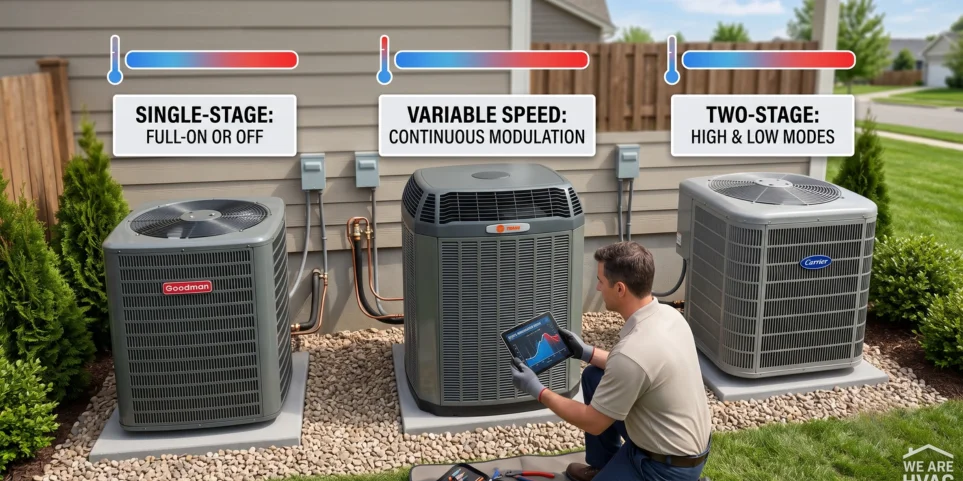
In air conditioning, the stages of cooling refer to the system’s ability to vary its output to match the heat load of the home. Rather than just turning on and off at full blast, modern systems use one, two, or variable stages to increase energy efficiency and indoor comfort.
The Three Types of Cooling Stages
1. Single-Stage Cooling (100% or 0%)
- How it works: The compressor has one speed. It is either completely ON at full capacity or completely OFF.
- Behavior: When the thermostat calls for cooling, the system blasts maximum cold air until the target temperature is reached, then shuts down.
- Pros & Cons: It is the least expensive to install but causes frequent temperature swings, higher energy bills from constant starting/stopping, and poor humidity control because cycles are too short.
2. Two-Stage Cooling (Low or High)
- How it works: The compressor has two levels of operation—typically a low stage (around 65% to 70% capacity) and a high stage (100% capacity).
- Behavior: On mild days, the AC runs continuously in the low stage. This uses less energy and runs longer, which drastically improves dehumidification. On extremely hot days, it automatically steps up to the high stage to meet the demand.
- Pros & Cons: Offers a great balance of energy savings, quiet operation, and comfort, though it has a higher upfront cost than a single-stage system.
3. Variable-Capacity / Inverter Cooling (40% to 100%+)
- How it works: Uses an inverter-driven compressor that can modulate its speed in tiny increments (often 1% steps), ranging anywhere from 25% up to 100%+ capacity.
- Behavior: Instead of cycling on and off, it runs almost constantly at a very low, whisper-quiet speed. It adjusts its output in real-time to precisely counteract the heat entering the house.
- Pros & Cons: This is the most energy-efficient technology available, provides completely flat line temperature consistency, and offers unmatched dehumidification. The drawback is the premium upfront equipment cost.
Comparison of the Cooling Stages
| Feature | Single-Stage | Two-Stage | Variable-Capacity (Inverter) |
| Compressor Speeds | 1 Speed | 2 Speeds | Infinite / Variable Speeds |
| Energy Efficiency | Standard | High | Maximum |
| Humidity Removal | Poor | Excellent | Best |
| Temperature Swings | 2°F to 4°F | Under 1°F | Less than 0.5°F |
| Equipment Lifespan | Shorter (more wear from cycling) | Longer | Longest (smooth, soft starts) |