- Actuators
- Adapters
- Air Blowers
- Air Conditioners
- Air Curtains
- Air Purifiers
- Anemometers
- Axial fans
- Ball Valves
- Belimo
- Blowers
- Brackets
- Brass
- Brazing Rods
- Capacitors
- Carrier Parts
- Clamp Meters
- Cleaning Products
- Coatings
- Compressors
- Condensate Pumps
- Connectors
- Contactors
- Copper Capillary
- Copper Coils
- Copper Straight Tubes
- Copper Strainers
What are the benefits of a pressure independent control valve (PICV)?

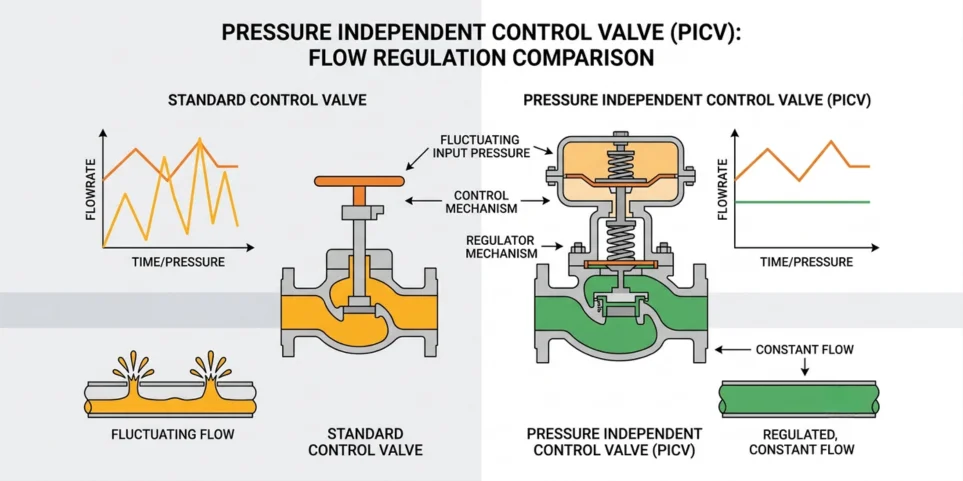
benefits of a pressure independent control valve (PICV)?
The main benefit of a pressure independent control valve (PICV) is that it maintains a constant water flow rate despite pressure fluctuations in a building’s heating or cooling system.
By combining a differential pressure regulator, a control valve, and a balancing valve into one single unit, a PICV delivers several key advantages for commercial HVAC systems:
Energy and Cost Savings
- Prevents Overflow: Standard valves allow excess water to pump through closer coils when system pressure spikes, wasting significant pump energy.
- Maximizes Delta T (Δ T): By maintaining exact design flow rates, water spends the optimal amount of time inside the coil to transfer heat, keeping chiller and boiler plants operating at peak efficiency.
- Reduces Pump Work: The system eliminates unnecessary water circulation, lowering overall variable-speed pump electricity consumption.
Superior Indoor Comfort
- Eliminates Temperature Swings: Fluctuations in other parts of the building do not affect local flow, ensuring steady, precise room temperature control.
- Prevents Hunting: Actuators do not constantly adjust back and forth trying to compensate for pressure changes, which stabilizes the entire system.
- Quiet Operation: Controlled fluid velocities eliminate the whistling and rushing noises often caused by high pressure and overflow.
Simplified Engineering and Installation
- Three-in-One Component: Replaces the separate control valve, balancing valve, and differential pressure regulator, drastically lowering installation labor costs.
- No Complex Calculations: Engineers only need to know the required flow rate, eliminating the need for complex control valve sizing and authority calculations.
- Easy Commissioning: Balancing technicians can set the flow rate directly on the valve dial without performing tedious, iterative manual balancing across the entire building network.