

- Actuators
- Adapters
- Air Blowers
- Air Conditioners
- Air Curtains
- Air Purifiers
- Anemometers
- Axial fans
- Ball Valves
- Belimo
- Blowers
- Brackets
- Brass
- Brazing Rods
- Capacitors
- Carrier Parts
- Clamp Meters
- Cleaning Products
- Coatings
- Compressors
- Condensate Pumps
- Connectors
- Contactors
- Copper Capillary
- Copper Coils
- Copper Straight Tubes
- Copper Strainers
what happens when you connect or use a pressure washer with impure electrical wire extensions

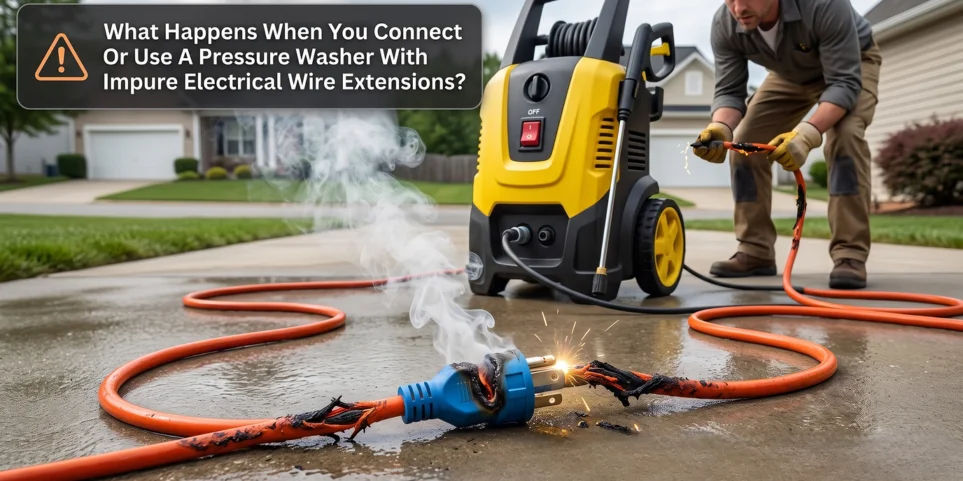
Do you know what happens when you connect or use a pressure washer with impure electrical wire extensions?
Never Use Pressure Washer or Vacuum Pumps with Impure Electrical Wire Extensions
When a pressure washer or vacuum pump starts working, it draws a massive amount of electrical current (often 15 to 20 A or more) to power its high-torque motor. When this intense current hits an impure copper connection—like Copper-Clad Aluminum (CCA)—it triggers an immediate chain reaction of physical and electrical failures that can destroy your equipment or start a fire.
1. Instantaneous Overheating (Inrush Current Spike)
- The Cause: Electric motors require an enormous “inrush current” to jumpstart the pump. This spike can be up to three times higher than the running current.
- The Effect: Because impure copper has a much higher electrical resistance than pure copper, it acts like a bottleneck. The connection instantly converts this electrical bottleneck into extreme heat, sometimes melting the plug or outlet housing within seconds of flipping the switch.
2. Accelerated Thermal Expansion (The “Creep” Effect)
- The Cause: Aluminum and alternative alloys expand and contract at a much faster rate than pure copper when exposed to heat.
- The Effect: Every time the pressure washer or vacuum pump cycles on and off, the wire violently expands and contracts. This movement pushes the wire out from under the terminal screws of the outlet or plug, making the connection loose.
3. Immediate Electrical Arcing
- The Cause: The loose connection created by the thermal expansion leaves a microscopic air gap between the wire and the terminal.
- The Effect: Electricity is forced to jump across this gap to keep the pressure washer running. This creates an electrical arc (a sustained spark) that burns at temperatures exceeding 3000°C (5400°F), which instantly ignites nearby plastics, drywall, or framing.
4. Severe Voltage Drop and Motor Burnout
- The Cause: The high resistance of the impure wire chokes the flow of electricity to the machine.
- The Effect: The pressure washer or vacuum pump cannot get the voltage it needs to operate efficiently. The motor will struggle to turn, sound noticeably louder, lose water or air pressure, and eventually overheat and burn its own internal motor windings.
5. Rapid Galvanic Corrosion
- The Cause: Pressure washer environments are naturally wet, humid, or damp.
- The Effect: When moisture mixes with the contact point of two dissimilar metals (like the aluminum core of a CCA wire touching a brass outlet terminal), it triggers rapid galvanic corrosion. This corrosion builds a crusty, non-conductive layer that permanently ruins the connection and creates even higher resistance.