

- Actuators
- Adapters
- Air Blowers
- Air Conditioners
- Air Curtains
- Air Purifiers
- Anemometers
- Axial fans
- Ball Valves
- Belimo
- Blowers
- Brackets
- Brass
- Brazing Rods
- Capacitors
- Carrier Parts
- Clamp Meters
- Cleaning Products
- Coatings
- Compressors
- Condensate Pumps
- Connectors
- Contactors
- Copper Capillary
- Copper Coils
- Copper Straight Tubes
- Copper Strainers
Are refrigeration oils hygroscopic?

Are refrigeration oils hygroscopic?
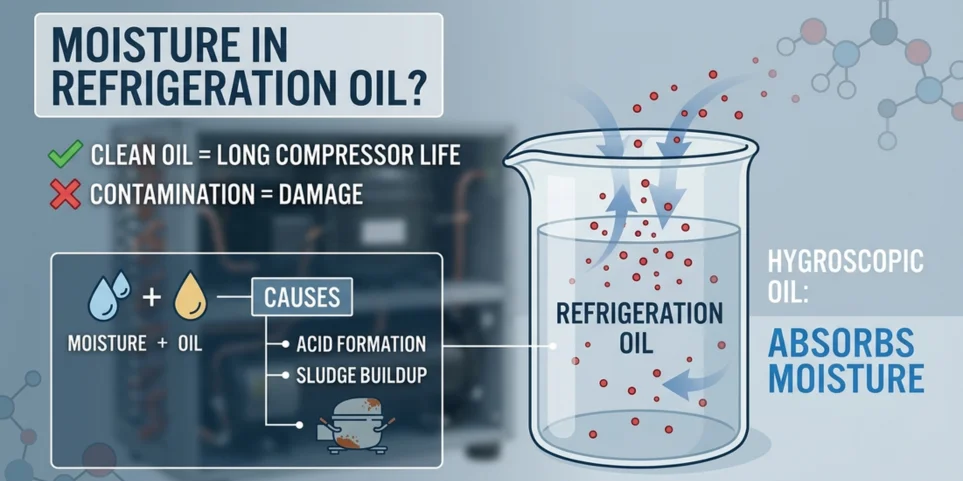
Yes, most modern synthetic refrigeration oils are highly hygroscopic, meaning they rapidly attract and absorb moisture directly from the ambient air. Because a refrigeration system operates in a completely sealed loop, any moisture absorbed by the oil can freeze into ice crystals, block expanding valves, and destroy system efficiency.
Hygroscopic refers to the ability of a substance to attract and absorb moisture (water vapor) directly from its surrounding environment.
Synthetic Oils (Extremely Hygroscopic)
Modern synthetic lubricants are designed to mix well (be miscible) with eco-friendly HFC and HFO refrigerants, but this polar molecular structure causes them to act like a sponge for water:
- PAG (Polyalkylene Glycol): Primarily used in automotive air conditioning. PAG is the most hygroscopic refrigeration oil in use. It draws in water vapor extremely fast, though it chemically “locks” the moisture inside to prevent immediate reactions.
- POE (Polyol Ester): The standard choice for commercial and residential HVAC/R systems. While slightly less aggressive at absorbing ambient moisture than PAG, water ingress is much more dangerous for POE. Water triggers a chemical reaction called hydrolysis, breaking the POE oil down into destructive acids and sludge that ruin compressor components.
- PVE (Polyvinyl Ether): An alternative synthetic with high stability, but it remains heavily hygroscopic